 Canada
 United States
Comparison
Bacteria vs Algaecide for Ponds: Lifetime Cost of Biological vs Chemical Control
Algaecide kills algae fast but refuels the next bloom. Here is why beneficial bacteria plus aeration usually costs less over the seasons.
Last updated August 31, 2026
Algaecide kills algae fast but treats the symptom: the dead algae sinks, rots, and releases the nutrients that feed the next bloom, so you dose again and again. Beneficial bacteria plus aeration removes those nutrients and addresses the root cause. Bacteria is slower but durable and usually lower cost over multiple seasons.
Bacteria vs algaecide: which is better?
If your pond turns green every summer and you keep reaching for the same jug of copper, you have probably noticed the pattern: the water clears for a week or two, then the bloom comes right back. That is not bad luck, it is how algaecide works. It kills what is visible without touching what caused the algae in the first place.
Beneficial bacteria plus aeration takes the opposite approach. Instead of killing algae, it removes the excess nutrients and low-oxygen conditions that let algae take over. It is slower, and it asks for a little patience, but it is the durable path and usually the lower-cost one once you add up several seasons of chemical bills. This guide walks through how each one actually works, why algaecide traps you in a repeat-dosing loop, and how to compare the true lifetime cost.
Algaecide treats what you can see. Bacteria and aeration treat what caused it.
How each one works
Copper algaecide: kills fast, then the algae sinks and rots
Copper-based algaecides are effective at what they are designed to do: they kill algae quickly. Within a day or two the green haze clears and the pond looks better. The problem is what happens next. All that dead algae does not disappear, it sinks to the bottom and decomposes. As it rots it consumes oxygen and releases the very nutrients, phosphorus and nitrogen, that fed the bloom to begin with. Those nutrients then fuel the next bloom, which is why the cycle repeats.
There is a second cost that is easy to miss. Copper does not break down. Over repeated treatments it accumulates in the sediment, where it can stress fish and the beneficial organisms that would otherwise help keep the pond in balance. You are not just paying for the next dose, you are slowly loading the bottom of your pond with metal.
Bacteria plus aeration: removes the nutrients that feed algae
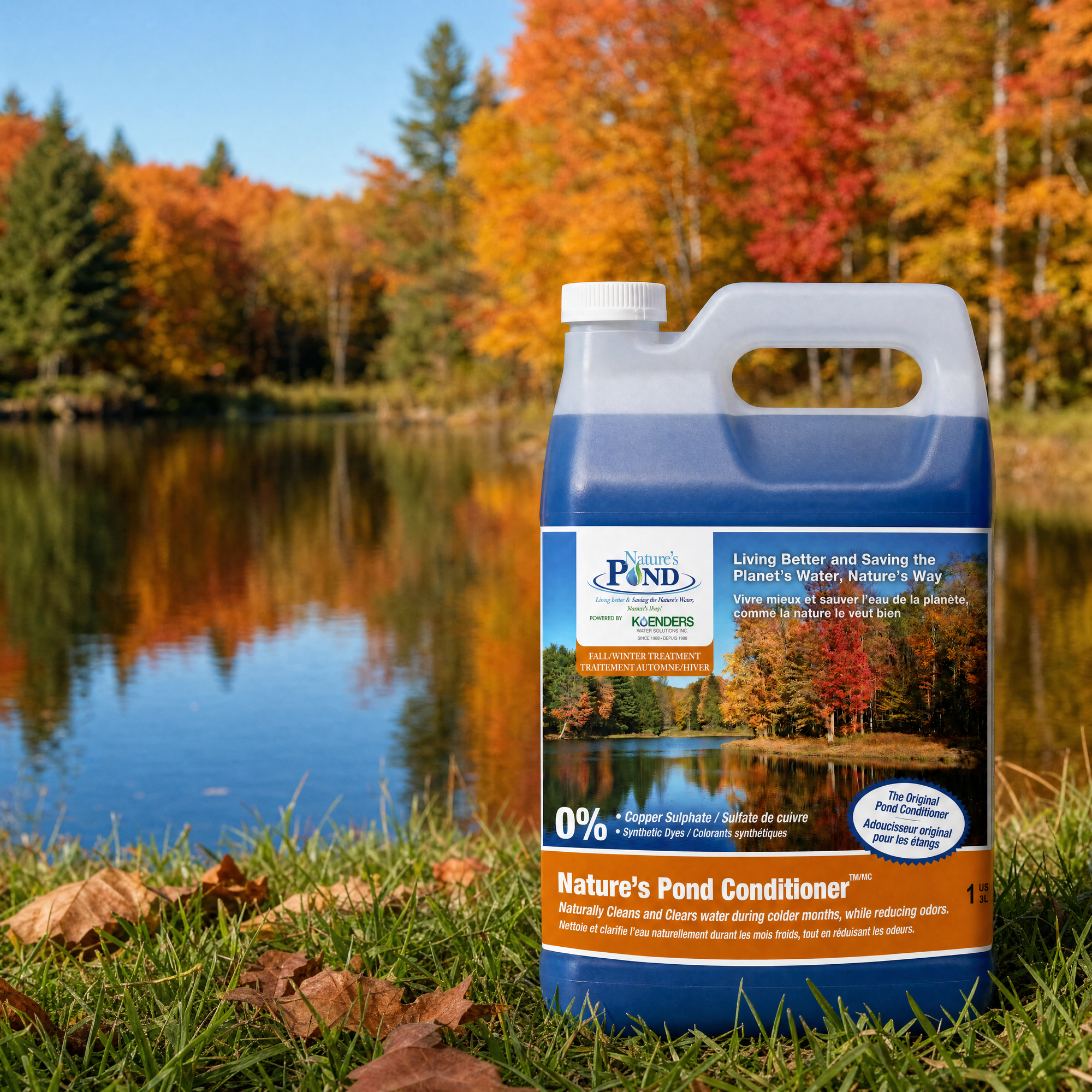
Nature's Pond Conditioner is an all-natural blend of beneficial bacteria, enzymes, and plant extracts with a food-grade dye. The bacteria digest the organic waste, fish waste, dead plants, and bottom muck, that would otherwise rot and feed algae, converting those organics to carbon dioxide and water. As they work, they compete directly with algae for the phosphorus and nitrogen in the water. Starve the algae of its food supply and the blooms have nothing to grow on.
The catch, and it is the one most sellers skip, is oxygen. The bacteria that digest muck fastest are aerobic, so they need dissolved oxygen to do their job. That is why bacteria and aeration are paired: bottom-up aeration keeps the sediment layer oxygenated so the bacteria stay active where the muck actually is. Copper sulphate kills algae that then sinks and rots and refuels the next bloom, so aeration plus biology is the approach that actually holds. To go deeper on the mechanism, see get rid of pond algae naturally.
The copper feedback loop
Here is the part that explains a lot about how the algae-control aisle is built. Because copper algaecide kills algae that then rots and releases nutrients, the pond is primed to bloom again on a predictable cycle. So you buy more algaecide. And because copper also kills beneficial bacteria, the natural digestion that would slowly draw down those nutrients never gets a foothold.
That is why so many chemical-first programs sell you an algaecide and a weekly bacteria packet in the same box. The algaecide keeps killing the bacteria, so the bacteria never builds a real population, so you keep buying both. It is a loop that is very good for repeat sales and not especially good for your pond or your wallet. Breaking the loop means stopping the thing that keeps resetting your pond to zero.
Does algaecide kill beneficial bacteria?
Yes. Copper-based algaecides are broad-spectrum: they do not distinguish between the algae you want gone and the beneficial bacteria you want to establish. Ultraviolet clarifiers have a similar effect, killing microbes as the water passes through. This matters because it means you cannot simply dose both at the same time and expect the bacteria to work. If you have just applied a copper product, the bacteria you add on top of it are largely wasted.
If you must use an algaecide for an immediate knock-down, the sequence matters. Apply the algaecide, let the interval on the label pass, then reintroduce bacteria and run aeration so the decaying algae does not crash your oxygen. For the fuller answer on why the natural side holds up, read does the natural approach actually work?
Lifetime cost of ownership
The single treatment prices can look similar on the shelf, so the honest comparison is not one jug against one bag. It is the total cost of keeping a pond clear over several seasons. Algaecide is a recurring expense by design: because it treats the symptom, you buy it again every time the bloom returns, often multiple times per summer, every summer, indefinitely.
Beneficial bacteria plus aeration front-loads the cost differently. You invest in an aeration system once, and that hardware is durable and runs for years. The bacteria is an ongoing input, but its job is to shrink the nutrient load over time, so the pond needs less intervention as it comes into balance rather than more. Over a multi-year horizon, removing the root cause typically wins on lifetime cost because you stop paying to fight the same bloom over and over.
| Approach | What it does | Root cause or symptom | Residue | Lifetime cost |
|---|---|---|---|---|
| Copper algaecide | Kills algae fast | Treats the symptom | Copper accumulates in sediment | Recurring, every bloom |
| Beneficial bacteria + aeration | Removes nutrients, digests muck | Treats the root cause | None; converts organics to CO2 and water | Durable, lower over the seasons |
As a sense of scale, published market coverage of algae control on larger shared waterbodies has cited recurring chemical programs running into the thousands of dollars per year, one market example put an HOA pond near $6,000 annually. Treat that as an illustration of how fast recurring chemical costs add up on a big waterbody, not a quote for any specific pond. The point holds at every size: recurring beats one-time only until you count the years.
What copper leaves behind
Beyond the annual bill, copper has a hidden ledger. Because it does not break down, every treatment adds to what is already in the sediment. That accumulation can reach levels that stress fish and the aquatic life you are trying to protect, and it does not reverse on its own. A biological program leaves nothing behind to accumulate: the bacteria convert organics to carbon dioxide and water and then die back when their food is gone. To weigh the copper-specific risks in full, see copper sulphate for pond algae.
When algaecide still has a role
This is not a claim that copper never has a use. If you are facing a heavy bloom on a swim date or a pond that is genuinely out of control, a knock-down treatment can buy you time. The mistake is treating that emergency tool as your whole program. Used as a one-off, sequenced correctly, and followed by a real biological and aeration plan, an algaecide can be a bridge. Used as the only tool, it is the loop we described above.
- Sequence it: apply the algaecide first, then wait the labelled interval before adding bacteria.
- Protect oxygen: run aeration while the killed algae decays so a decomposition oxygen crash does not kill your fish.
- Have a plan to phase it out: the goal is to reduce or replace repeat dosing, not to schedule it forever.
- Always follow the current product label for any dosing, timing, and re-entry guidance.
The root-cause approach: the 3-step program
The reason the biological side is durable is that it is not a single product, it is a system that addresses why the pond blooms. The 3-step Pond Care Program lays it out as Renew, Revive, and Remove.
- Renew: condition the water with the beneficial bacteria and enzyme blend so the microbes that digest muck and out-compete algae have a strong population.
- Revive: aerate, because the bacteria need dissolved oxygen and bottom-up aeration keeps the sediment aerobic where the muck sits.
- Remove: take out what biology cannot, mechanically pulling heavy weeds and debris while the bacteria handle the organic load.
Run together, those three steps draw the nutrient load down season over season, which is exactly the thing copper can never do because it keeps putting nutrients back. If you manage a shared waterbody, the same logic scales up: see algae control for community and HOA ponds for how larger ponds move off recurring chemicals.
Make the switch
If you are tired of buying the same algaecide every few weeks and watching the pond turn green again, the switch is straightforward: start with the beneficial bacteria conditioner, pair it with aeration, and give it a full season to draw the nutrients down. If you want a hand sizing the right conditioner and aeration for your pond, contact our pond experts for a free estimate and we will build a recommendation around your acreage, depth, and goals.
Related
- Get rid of pond algae naturally The chemical-free algae playbook
- Do pond bacteria treatments actually work? The honest, evidence-based answer
- Copper sulphate for pond algae Hidden costs and safer alternatives
- The 3-step Pond Care Program Renew, Revive, Remove
- Nature's Pond Conditioner The beneficial bacteria blend
- Algae control for HOA and community ponds Move shared water off chemicals
FAQ