 Canada
 United States
How-to
Clean Livestock Water: How to Treat Stock Tanks, Troughs, and Dugouts (Without Harsh Chemicals)
One water problem across three vessels, one durable fix. Treat the cause of green, black, and smelly livestock water with fish-safe bacteria and aeration instead of chemicals.
Last updated August 31, 2026
Clean livestock water starts by treating the cause, not the symptom: excess nutrients, low dissolved oxygen, and an anaerobic bottom drive algae, muck, and odour. For portable tanks, clean regularly and add fish-safe beneficial bacteria. For dugouts, run continuous bottom aeration. Beneficial bacteria plus aeration is the durable, animal-safe alternative to bleach or copper sulphate.
Green slime in the trough. Black, stinking water in the dugout. A thick scum that appears overnight in the July heat. If you run cattle or horses, you have almost certainly reached for the cheap habit: a slug of bleach, a scoop of copper sulphate, and a repeat performance a week later. It works for a few days, then the water goes right back to green. That cycle is not a coincidence. It is what happens when you keep treating the symptom and never touch the cause.
This guide pulls the whole picture into one place: the three vessels you actually manage (portable stock tanks, fixed troughs, and earthen dugouts or ponds), the one root cause behind all of them, and a safety-ranked path to clean water that does not corrode your tanks, harm your animals, or refuel the next bloom. The through-line is simple and it is the same one the Renew, Revive, Remove program is built on: fix the water, not just the colour.
Three vessels, one root cause
A 50-gallon poly trough and a two-acre dugout look like completely different problems. Biologically, they are the same problem at two scales. Green water, muck, and the rotten-egg smell almost always trace back to the same three drivers working together.
- Excess nutrients. Phosphorus and nitrogen from manure, runoff, spilled feed, dust, and decaying organic matter are food for algae. The more nutrients pile up, the more algae you grow.
- Low dissolved oxygen. Still, warm, sunlit water holds little oxygen. Without oxygen, the helpful aerobic organisms that would digest waste cannot do their job.
- An anaerobic bottom. When the bottom runs out of oxygen, a different set of bacteria take over and produce hydrogen sulphide, the rotten-egg gas, along with black, septic muck.
Bleach and copper sulphate ignore all three. They knock back the visible algae, but the nutrients stay, the oxygen stays low, and the dead algae sinks, rots, and hands its nutrients back to the next bloom. That is why the chemical route never ends. The durable answer treats the drivers directly: add oxygen so the water stays aerobic, and add beneficial bacteria so the nutrients get digested instead of stockpiled.
Green, black, and smelly water are three symptoms of one imbalance: too many nutrients, too little oxygen, and a bottom gone septic. Fix those, and the symptoms stop coming back.
Portable stock tanks and troughs (small volume, fast turnover)
Why they green up and smell
A stock tank is a small, warm, sunlit bowl of nutrient-rich water, which is close to a perfect algae incubator. Sun drives photosynthesis, spilled feed and saliva add nutrients, and still water lets a film establish on the walls in days. Because the volume is small, you can manage a tank directly: clean it, shade it, keep it moving, and seed it with organisms that eat the nutrients before algae can.
The options, ranked by safety
There is a hierarchy here, and it is worth respecting. The safest, most durable methods sit at the top; the ones with withdrawal times, corrosion, and species-specific danger sit at the bottom.
- Empty, scrub, and shade. The single most effective move. Drain the tank on a regular schedule, scrub the walls to break the algae film, refill, and shade it from direct sun with a lid, a partial cover, or placement. Removing the biofilm and cutting the light does more than any additive.
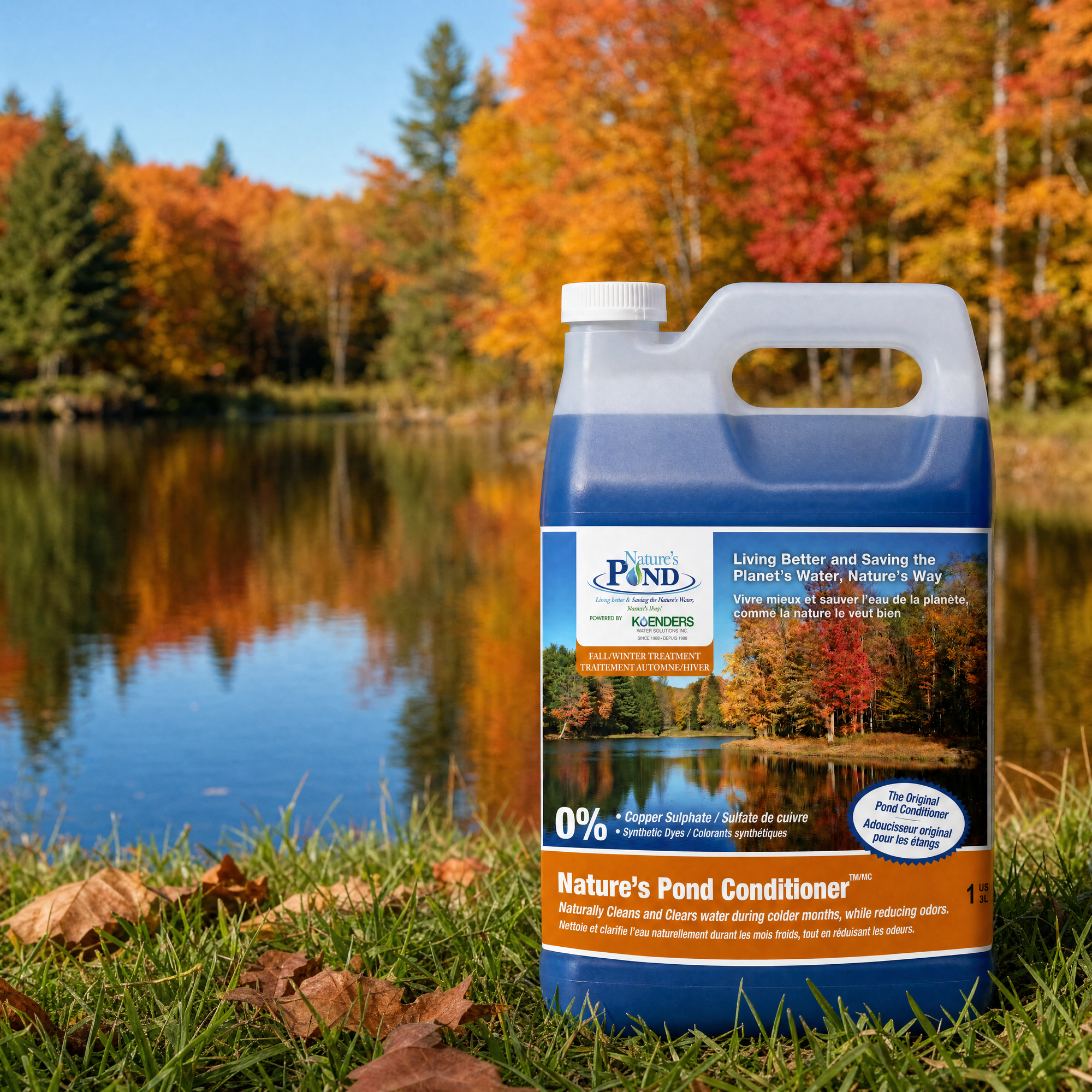
- Fish-safe beneficial bacteria. Nature's Pond Conditioner is a blend of beneficial bacteria and enzymes that digests the organic load feeding algae. It is safe for fish, pets, livestock, and wildlife when used as directed, so there is no drinking-water withdrawal. This is the set-and-forget layer that stretches the time between scrubbings.
- Keep it moving. Even light circulation discourages the surface film and raises oxygen. On a small tank a simple recirculating pump helps; on a larger trough, aeration earns its keep.
- Barley straw. Can suppress new algae slowly as it decomposes, but it works only as prevention, acts slowly, and adds organic load if overused. A mild aid, not a fix.
- Goldfish. Eat some algae and mosquito larvae in larger tanks, but they add their own waste, need the tank to stay unfrozen and un-chlorinated, and are a minor helper at best.
- Bleach. Sanitizes and clears slime short-term, but it must be dosed carefully, given contact time, and allowed to dissipate before animals drink freely. It also kills the very beneficial bacteria you are trying to build, so it is a deep-clean tool, not an ongoing program.
- Copper sulphate. Kills algae fast, but it corrodes metal tanks and pipes, is dangerous to sheep, and only sinks dead algae that rots and re-blooms. The worst fit for ongoing tank care.
For a full walk-through of these seven, see the ranked stock-tank algae methods. The short version: clean, shade, and dose fish-safe bacteria, and reach for the chemicals only for the occasional reset.
Earthen dugouts and ponds (large volume, seasonal turnover)
Black water and the rotten-egg smell
A dugout is a different animal. You cannot drain and scrub two acres, and dumping chemicals into that volume is both expensive and self-defeating. Dugouts also stratify: through summer, warm water floats on top of cold, oxygen-starved water below. That deep layer goes anaerobic, sulphate-reducing bacteria take over, and you get hydrogen sulphide, the rotten-egg smell, plus black septic muck on the bottom. A cold front or heavy rain can then flip the layers and drag that oxygen-poor water to the surface, which is when a dugout turns black and foul overnight. If you want the mechanism in detail, here is why water smells like rotten eggs.
Continuous aeration at the source
Because you cannot clean a dugout by hand, you manage it by keeping it aerobic. Continuous bottom-diffused aeration pushes air to the deepest point, breaks the stratification, and holds oxygen through the whole water column so the bottom never goes septic. Bottom-up diffused aeration outperforms a surface splash for this because it destratifies the whole column rather than just rippling the top. Add beneficial bacteria on top of aeration and the aerobic organisms digest the organic muck the low-oxygen bottom had been storing.
The catch on most pasture dugouts is power: there is no line out there. That is where off-grid options matter. A windmill aerator drives an air compressor on wind alone, no power line, batteries, or fuel required, and pushes air to a bottom diffuser. Solar aerators run on panels for sunny, low-wind sites. Koenders has been building windmill aerators since 1988, which is why off-grid windmill aeration for dugouts is often the answer for remote water. For the full black-to-clear treatment sequence, see dugout water treatment for cattle.
The safety matrix: cattle, sheep, and horses are not the same
One reason the chemical habit is risky is that a dose that is fine for cattle can be lethal to sheep. This is the detail most single-lever product pages skip.
- Sheep and copper sulphate do not mix. Sheep are extremely sensitive to copper and store it in the liver, so a rate that cattle tolerate can accumulate to fatal copper toxicity in sheep. Never use copper sulphate in water shared with sheep.
- Bleach affects intake. Heavily chlorinated water tastes off, and animals of every species will drink less of it, which quietly drags down performance. Bleach also demands contact time and dissipation before free drinking.
- Blue-green algae is a separate, acute danger. A thick, paint-like or pea-soup scum can be a toxic cyanobacteria bloom, which can be lethal to any livestock. Treat any heavy scum as dangerous until ruled out, and learn to spot a toxic bloom before your herd drinks it.
The through-line: the biological route, cleaning plus fish-safe bacteria plus aeration, carries none of these species traps. No withdrawal, no corrosion, no copper danger. It is the one path that is safe across cattle, horses, and sheep alike.
The honest tradeoffs, side by side
Here is every common method laid against the questions that actually matter on a working operation: how it works, what it does to the animal, which vessel it fits, and what it costs you in recurring labour.
| Method | How it works | Animal-safety note | Vessel fit | Recurring cost or labour | Verdict |
|---|---|---|---|---|---|
| Clean + shade | Removes biofilm and cuts the light algae needs | No risk | Tanks, troughs | Regular scrubbing; low material cost | Foundation of every routine |
| Beneficial bacteria | Digests the nutrients that feed algae | Fish- and livestock-safe as directed; no withdrawal | Tanks, troughs, dugouts | Scheduled dosing; low labour | The durable set-and-forget layer |
| Aeration | Adds oxygen, keeps water aerobic, stops septic bottom | No risk; improves palatability | Dugouts, ponds, large troughs | Runs continuously; off-grid options exist | The core fix for large water |
| Barley straw | Slowly suppresses new algae as it decomposes | Low risk; adds organic load if overused | Tanks, small ponds | Replace seasonally | Mild prevention aid, not a fix |
| Goldfish | Graze some algae and larvae | Low risk; add their own waste | Larger tanks | Ongoing care; freeze/chlorine sensitive | Minor helper only |
| Bleach | Sanitizes and clears slime short-term | Withdrawal and taste; reduces intake | Tanks, troughs | Frequent re-dosing plus scrubbing | Deep-clean reset, not a program |
| Copper sulphate | Kills algae that then sinks and re-blooms | Toxic to sheep; corrodes metal | Not recommended | Constant re-dosing | Highest risk, lowest durability |
The durable fix: a biological + aeration program
Notice that the top of that table is not one product. It is a small system: keep water clean and oxygenated, and feed it organisms that eat the nutrients. That is the whole idea behind the Renew, Revive, Remove program, applied to livestock water.
- Renew conditions the water with beneficial bacteria and enzymes that convert the organic load to carbon dioxide and water, drawing down the nutrient stockpile that algae and muck depend on.
- Revive adds oxygen through aeration so the water stays aerobic, the bottom stops going septic, and those bacteria can actually work. Bacteria and oxygen are a pair: neither does the full job alone.
- Remove takes out what is left mechanically, heavy weed mats or accumulated bottom debris, so the biology is not fighting a backlog.
This is why the durable route beats chronic dosing on lifetime cost as well as safety. A chemical is an expense you pay again every week, forever. A program draws the cause down and holds it, so the water gets easier to manage over a season rather than harder. Nature's Pond Conditioner is an all-natural blend of aerobic and anaerobic beneficial bacteria, enzymes, and plant extracts with a food-grade dye; it is non-pathogenic and safe for fish, pets, livestock, and wildlife when used as directed.
How to size it (head count to water demand to aeration)
Sizing is where people either overspend or, more often, undersize and give up. Two numbers drive it: how much water your animals need, and how much water you are treating.
- Start with demand. Larger herds, hot weather, and lactating or growing animals all raise daily water intake sharply, which is one more reason poor, unpalatable water quietly costs you: animals drink less of it.
- Size aeration by the water body, not the herd. For a dugout or pond, what matters is surface area and average depth. A rough volume figure is surface acres multiplied by average depth in feet, which gives acre-feet. Depth matters: deeper water stratifies harder and benefits most from bottom-up diffused aeration.
- Match dosing to volume too. Beneficial bacteria are dosed to the size of the water, with a fuller startup dose to establish the colony, then maintenance doses through the warm season.
There is no single per-acre number that fits every shape, depth, and wind exposure, and guessing is how systems end up undersized. Rather than a calculator, our in-house pond experts will size a system for your exact water and give you a free recommendation. Contact our pond experts for a free estimate with your dugout dimensions and head count, and start from the right size the first time.
Is your water actually safe? When to test
Clean-looking water is not the same as safe water, and this is the limit of any treatment: aeration and bacteria fix algae, muck, odour, and palatability, but they do not remove dissolved salts. If the salts are high, you have a testing-and-sourcing question, not a treatment question.
- Test a new source (a fresh dugout, pond, or well) before you rely on it.
- Test after a drought, which concentrates dissolved salts as water levels drop.
- Test if animals go off water or lose condition with no other explanation.
- Ask the lab for sulphate, nitrate, and total dissolved solids (TDS), the parameters that most often make water quietly unsuitable for livestock.
For the numbers behind these parameters and where the thresholds come from, see the deeper guide on whether your pond or dugout water is safe for cattle. If the salts check out, a biological plus aeration program takes care of the rest.
The bottom line
You manage three vessels, but you are solving one problem. Green, black, and smelly water all come from too many nutrients, too little oxygen, and a bottom gone anaerobic. Bleach and copper sulphate treat the colour and leave the cause, so the problem returns and, in the case of copper and sheep, can turn deadly. Clean and shade your tanks, dose them with fish-safe bacteria, aerate your dugouts around the clock, and let a program hold the water clear. It is safer for every animal you run, and it costs less over a season than dosing forever.
Ready to stop chasing green water? Start with the Renew, Revive, Remove program, see the tailored guidance for stock tanks and troughs, or talk to our pond experts for a free recommendation sized to your water.
Related
- Stock tanks and troughs pond care Tailored care for small livestock water vessels
- The Renew, Revive, Remove program The 3-step natural pond care system
- Nature's Pond Conditioner Fish-safe beneficial bacteria and enzymes
- Off-grid windmill aeration for dugouts Wind-powered aeration with no power line
- Dugout water treatment for cattle Fix black, smelly dugout water at the source
- How to get rid of stock-tank algae Seven methods ranked safest first
FAQ