 Canada
 United States
Natural care
Does Barley Straw Really Work for Pond Algae? What University Research Actually Shows
Barley straw can help prevent pond algae, but it works slowly and does little to clear a bloom that has already started. Here is the honest, research-based picture.
Last updated August 31, 2026
Barley straw can help prevent pond algae but works slowly and inconsistently, and it does little to clear an existing bloom. As it breaks down, it is thought to release compounds that inhibit new algae growth, so it acts as prevention, not a cure. University extension trials show mixed results, and it must be added early, before algae takes hold.
The quick answer
Barley straw is one of the oldest natural pond remedies, and the question everyone asks is fair: does barley straw actually work for pond algae? The honest answer from university research is yes, but only as slow, partial prevention. As the straw decomposes it is thought to release compounds that discourage new algae growth. It does not kill algae that is already there, it works over weeks rather than days, and results are famously inconsistent from pond to pond.
If your water is already green or ropey with string algae, barley straw will not rescue it this season. Where it earns its place is as a low-cost preventive layer added early, before the water warms. Below we walk through how it is supposed to work, what extension trials really found, how much people use, and where a paired biological approach is more dependable. If you want the full picture first, start with the complete natural algae guide.
Barley straw is prevention, not a cure. It cannot clear a bloom that has already taken hold.
How barley straw is supposed to work
The theory is straightforward. When a bale of barley straw sits in oxygenated water and begins to rot, the decomposition process is thought to release plant compounds that suppress the growth of new algae cells. Crucially, the straw does not poison existing algae the way an algaecide does. Instead it is believed to make the water a slightly less friendly place for the next generation of algae to establish.
Two conditions matter for any effect at all. First, the straw needs oxygen to break down aerobically, which is why it is placed near the surface in a loose, floating cage or net rather than sunk to the bottom. Second, it needs time. The straw has to be well into decomposition before it does anything, so it is always added ahead of the problem, not in response to it.
That mechanism explains both barley straw's appeal and its limits. It is genuinely natural and inexpensive, but it treats a symptom of a deeper issue. The real drivers of a green pond are excess nutrients (phosphorus and nitrogen), low dissolved oxygen, and anaerobic bottom sediment. Barley straw touches none of those root causes directly, which is why understanding why your pond turns green matters more than any single remedy.
What university research actually shows
Barley straw has been studied by extension programs for decades, and the picture that emerges is nuanced rather than a clean win. It is one of the few DIY remedies with real published data behind it, so it deserves an honest read rather than either hype or dismissal.
Better at prevention than cure
The strongest and most consistent finding is that barley straw is a preventive. Added early, while a pond is still clear, it may slow the onset of a bloom. Added to a pond that is already green, it does little. This is the single most important expectation to set: if you are searching for barley straw because the water has already turned, you have most likely missed the window for it to help this year.
Mixed results on string algae vs green water
Trials disagree on which type of algae responds. Some studies show a preventive effect on filamentous (string) algae, the ropey mats that cling to rocks and the surface. Others show more effect on the suspended, single-celled algae that causes green, pea-soup water, and still others show little effect on either. In practice this means barley straw is unreliable as a standalone fix for any specific algae type. For string algae in particular, mechanical removal paired with biology tends to be far more dependable, as covered in our string-algae and green-water guides.
It is slow and inconsistent
Even when barley straw works, it works slowly. The straw must decompose before it has any effect, which extension sources describe as taking several weeks after it is added. Pond-to-pond variation is large: water temperature, sunlight, how much straw is used, and how nutrient-loaded the pond is all change the outcome. That combination of a long lag and unpredictable results is why so many pond owners try barley straw once, see little change, and conclude it does not work at all.
| Question | What research supports |
|---|---|
| Does it prevent algae? | Sometimes, if added early and given time |
| Does it cure an active bloom? | No, little to no effect once algae is established |
| How fast? | Slow: several weeks to begin, after the straw decomposes |
| String algae or green water? | Mixed and inconsistent across trials |
| Reliable on its own? | No, results vary widely pond to pond |
How much barley straw per acre, and when to add it
Published extension guidance commonly cites roughly 225 pounds of barley straw per surface acre as a starting rate, a figure associated with Rutgers NJAES Extension. That number is an external research reference, not a Nature's Pond recommendation, and it is best treated as a starting point rather than a guarantee. Ponds that are more algae-prone, warmer, or more nutrient-loaded may need adjustment, and because results vary so much, no single rate reliably solves every pond.
Timing matters more than the exact weight. Barley straw has to be in the water before the season warms and algae takes off, so it has time to decompose and reach its active phase before bloom season. A few practical points from extension guidance:
- Add it early. In spring, before the water warms, so decomposition is underway before algae would normally bloom.
- Keep it near the surface. Loose in a floating net or cage so it decomposes with plenty of oxygen, not sunk to the bottom.
- Do not overload the pond. A large amount of straw all rotting at once consumes oxygen, which can stress fish. Aerating the pond makes any natural approach safer and more effective.
- Expect to replace it. The straw loses effect as it fully breaks down, so it is a recurring seasonal chore, not a one-time fix.
Notice how many of those cautions come back to oxygen. Decomposing organic matter of any kind, straw included, draws down dissolved oxygen, and low oxygen is one of the exact conditions that feeds the next algae problem. That is the core tension of barley straw as a standalone tool.
Barley straw vs beneficial bacteria and aeration
The more reliable natural approach flips barley straw's weaknesses into strengths. Instead of adding organic matter and hoping decomposition releases the right compounds, you add targeted beneficial bacteria that consume the excess nutrients feeding algae, and you pair it with aeration so those bacteria have the oxygen they need to work. This attacks the root cause (nutrient load and low oxygen) rather than a symptom.
| Factor | Barley straw | Beneficial bacteria + aeration |
|---|---|---|
| Prevention vs cure | Prevention only | Prevents and helps clear over time |
| Speed | Slow, several weeks after it decomposes | Faster and steadier once oxygen is in place |
| Consistency | Highly variable pond to pond | Predictable when dosed and aerated as directed |
| Clears an existing bloom? | No | Yes, gradually, by starving the nutrient source |
| Targets root cause? | No, adds organics | Yes, consumes excess nutrients |
| Effect on oxygen | Lowers it as straw rots | Aeration raises dissolved oxygen |
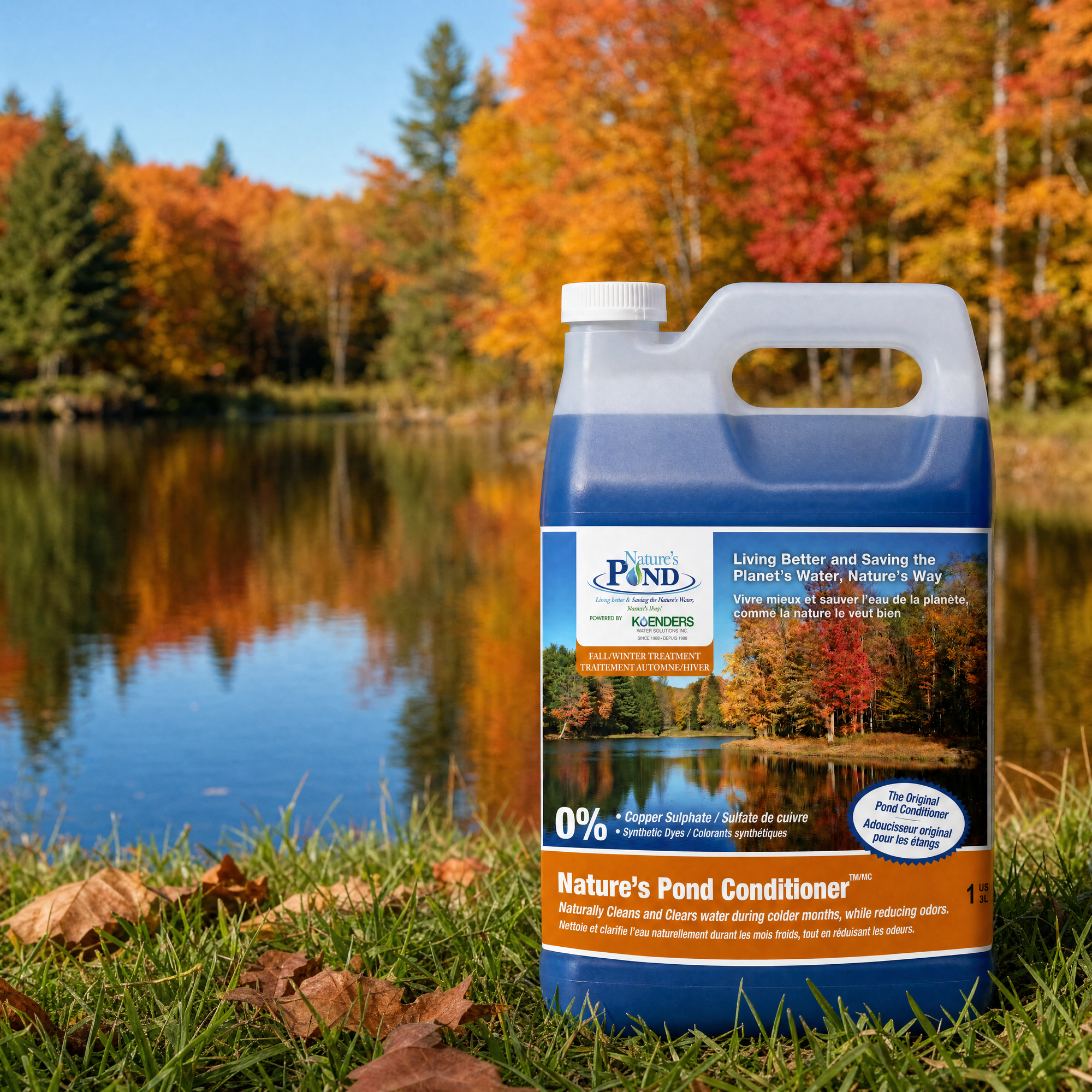
This is exactly the logic behind the 3-step natural program: Renew the water with beneficial bacteria, Revive it with aeration, and Remove the built-up muck mechanically and biologically. Nature's Pond Conditioner is an all-natural blend of aerobic and anaerobic bacteria, enzymes, and plant extracts with a food-grade dye. It converts organics to carbon dioxide and water, is non-pathogenic, and is safe for fish, pets, livestock, and wildlife when used as directed. Barley straw can sit alongside that program as an early preventive, but it is not a substitute for it.
Should you bother with barley straw?
Barley straw is worth trying if you fit a specific profile: you have a small, low-nutrient pond, you can add the straw early in spring, and you are treating it as one preventive layer rather than your only line of defence. In that context it is cheap, natural, and low-risk when you do not overload the pond and you keep oxygen up.
It is the wrong tool if your water is already green or matted with string algae, if you need results quickly, or if the pond is heavily loaded with nutrients from runoff, waterfowl, or years of accumulated bottom muck. In those cases the straw will disappoint, and the time spent waiting for it to work is time the bloom keeps feeding on. A biological approach paired with aeration is more dependable, and if you are unsure where your pond sits, our pond experts can give you a free recommendation.
Use barley straw as an early preventive layer if you like, but build your plan on nutrient control and oxygen, not on straw.
The honest bottom line
Barley straw is not a myth, and it is not a miracle. University research supports a modest, slow, inconsistent preventive effect when it is added early, and shows little value once algae has taken hold. If you enjoy natural, hands-on pond care and you plan ahead, there is no harm in adding it in spring. Just do not count on it to clear a green pond, and do not let it replace the two things that actually change the water: lowering the nutrients that feed algae and raising the oxygen that keeps the pond healthy.
Related
- How to get rid of pond algae naturally The complete natural algae guide
- Why is my pond water green? Root causes of green water
- What does beneficial bacteria do for a pond? The more reliable natural option
- Nature's Pond Conditioner All-natural beneficial bacteria blend
- The 3-step Pond Care Program Renew, Revive, Remove
- Talk to our pond experts Free, no-pressure recommendation
FAQ