 Canada
 United States
Sector guide
Pond and Lake Algaecide Permits and Regulations: What Shared-Water Owners Must Know
Do you need a permit or licensed applicator to treat pond algae? A plain-language guide for shared-water owners, plus the biological path that usually sidesteps the question.
Last updated August 31, 2026
Many states and provinces require a permit or a licensed applicator to apply aquatic algaecides and herbicides, and stocking grass carp is often permit-gated and limited to sterile triploid fish. Shared water can add owner-consent rules. A beneficial-bacteria and aeration program is generally not a regulated pesticide application, so it usually avoids the applicator-license question. Always confirm your local rules.
Do you need a permit to treat pond algae?
If you are staring at a green pond and reaching for a jug of algaecide, there is a question worth asking before you open it: are you allowed to apply this, and do you need a licence to do it? For a lot of pond and lake owners the honest answer is that they never checked, and for shared or connected water that can turn into a real problem.
Aquatic algaecides and herbicides are regulated pesticides. In the United States they are registered and label-governed under federal law, and in Canada they are regulated federally as well, with a layer of provincial rules on top. On top of that, individual states and provinces frequently add their own permit and applicator-licence requirements, especially for larger or shared waterbodies. The rules genuinely vary from one jurisdiction to the next, so the goal of this guide is to help you ask the right questions, not to give you legal advice.
The short version: a chemical treatment can carry permit, licence, and consent obligations, while a biological program built on beneficial bacteria and aeration usually does not fall into the regulated-pesticide category at all. That is a big part of why many shared-water owners choose the biological path. Whichever route you take, confirm the specifics with your state or provincial environmental agency or your local extension office first.
A regulated pesticide application can require a permit, a licensed applicator, and the other owners' consent. A beneficial-bacteria and aeration program usually avoids all three.
When a permit or applicator licence is required
There is no single national rule, but a few patterns show up almost everywhere. Understanding these helps you predict where you are likely to need paperwork before you treat.
Aquatic algaecides and herbicides
Copper-based algaecides and aquatic herbicides are the products most likely to trigger a permit or licence requirement. Many jurisdictions require a certified or licensed pesticide applicator to apply them, particularly on public, connected, or shared water, and some require a treatment permit filed in advance. The larger the waterbody and the more it connects to streams, wetlands, or a neighbour's pond, the more likely a permit is involved.
Two practical points follow from this. First, the product label itself carries the force of law: application rates, buffer zones, and water-use restrictions on the label are not suggestions. Second, hiring a licensed applicator does not make the regulatory question disappear; it moves it onto a professional who still has to work within the permit and label for your specific water.
Grass carp stocking and triploid rules
Stocking grass carp to graze down aquatic weeds is a biological control, but it is heavily regulated because an escaped fish can damage waters downstream. Many jurisdictions require a stocking permit, mandate sterile triploid grass carp so the fish cannot reproduce, and cap the number you may stock per acre. Stocking rates and rules differ significantly by state and province, so confirm the current limit and any permit for your area before you buy fish. Treat any specific per-acre number you read online as a starting point to verify, not a rule you can rely on.
Fountains, aeration, and equipment
Installing aeration or a fountain is not a pesticide application, so it does not raise the applicator-licence question. That said, work that disturbs a shoreline, a wetland, or a stormwater structure can have its own local permitting under different rules. If your waterbody is a regulated stormwater pond, check the maintenance agreement before major work. Adding oxygen to the water, by contrast, is the kind of proactive care that regulators generally want to see.
Shared and multi-owner water: consent and liability
Treating your own isolated pond is one thing. The moment a pond is shared between two properties, sits inside an HOA, or connects to a neighbour's water, the picture changes. Now a treatment is not just a regulatory question, it is also a question of who agreed to it and who is responsible if something goes wrong.
- Two owners, one pond. Applying an algaecide to water you only partly own, without the other owner's agreement, can create liability if fish die or the treatment drifts. Get written consent first.
- HOA and community ponds. On common-area water the board typically controls treatment decisions and carries the duty of care. See our guide to HOA responsibilities and budgeting for how that plays out.
- Connected or downstream water. If your pond feeds a creek, wetland, or another pond, a treatment can affect water you do not own, which is exactly the situation permits are designed to govern.
- Documentation. Whatever you do, keep a record of what was applied, when, at what rate, and who approved it.
For lakes and large ponds and HOA and community ponds, the consent-and-liability layer is often the deciding factor. A program that does not involve a regulated pesticide is simply easier to get everyone to sign off on, and easier to defend later.
How going biological usually avoids the applicator-licence problem
Here is the wedge that many owners miss. A beneficial-bacteria and aeration program is generally not a regulated pesticide application, because it does not use a registered pesticide to kill a target organism. Instead of poisoning algae, it removes the conditions algae need.
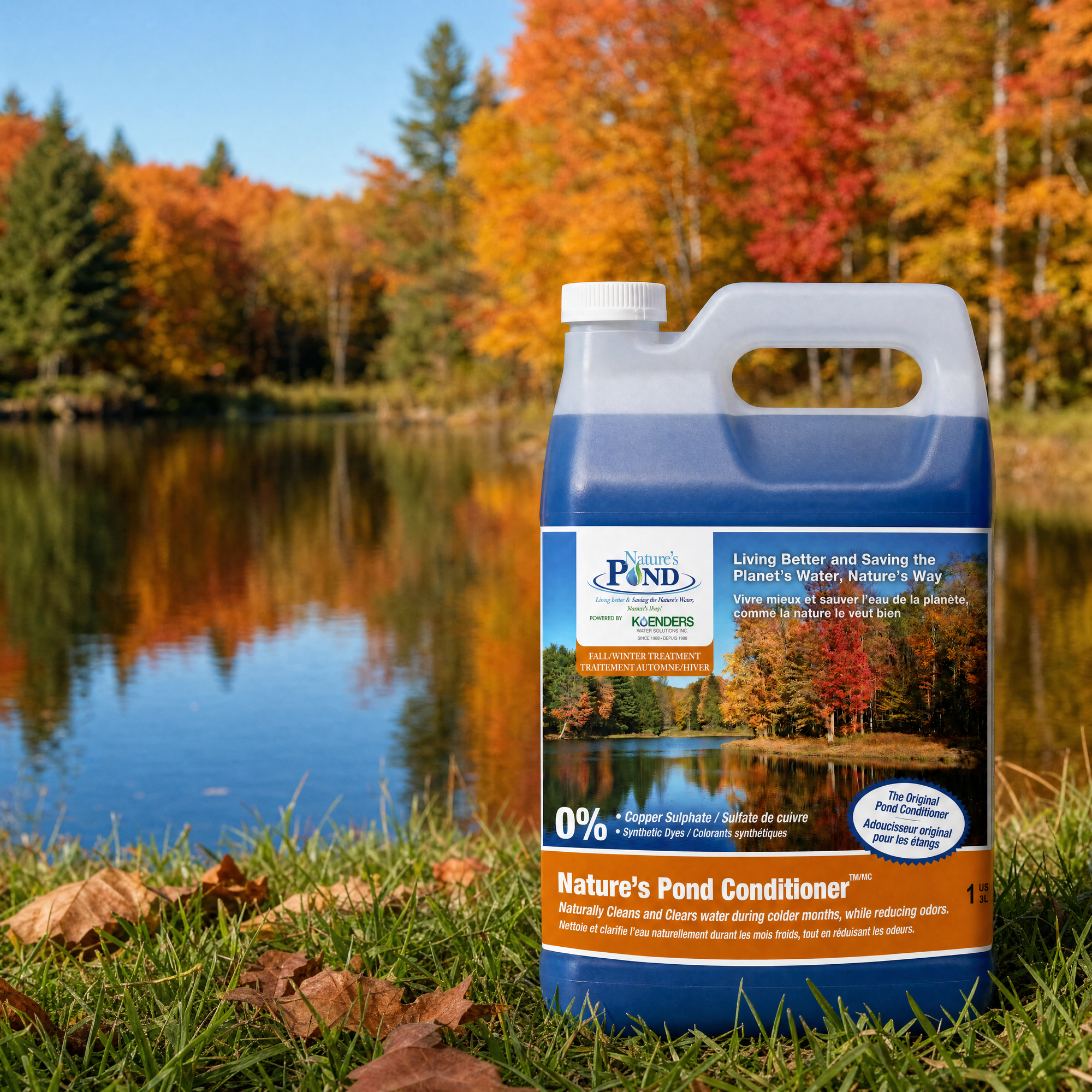
Nature's Pond Conditioner is an all-natural blend of aerobic and anaerobic beneficial bacteria, enzymes, and plant extracts with a food-grade dye. It works by digesting the organic muck and excess nutrients, the phosphorus and nitrogen, that feed algae in the first place, converting that organic load to carbon dioxide and water. It is non-pathogenic and safe for fish, pets, livestock, and wildlife when used as directed. Because it is not a pesticide, it does not raise the applicator-licence question the way copper sulphate does. Always read and follow the product label, and confirm your local rules, but the biological route sidesteps the pesticide-permit category entirely.
The other half of the program is oxygen. Bottom-up aeration raises dissolved oxygen and keeps the pond bottom aerobic, which is where beneficial bacteria do their best work. Aeration is equipment, not a chemical, so it carries no applicator licence. Together, aeration and beneficial bacteria form the durable, root-cause approach that our 3-step Pond Care Program is built on: Renew, Revive, Remove.
It is also worth understanding why the chemical route keeps you on the treadmill. Copper sulphate kills algae that then sinks, rots, and releases its nutrients back into the water, refuelling the next bloom. So you re-treat, and each re-treatment is another application that may need a permit or a licensed applicator. If you want the full breakdown, see the hidden costs and fish risk of copper sulphate.
Permit exposure by treatment type
| Treatment | Typically needs permit or licence? | Shared-water consent? | Notes |
|---|---|---|---|
| Copper sulphate / algaecide | Often yes | Yes | Registered pesticide; label has force of law; kills algae that then rots and refuels the bloom |
| Aquatic herbicide | Often yes | Yes | Frequently requires a certified applicator, especially on shared or connected water |
| Grass carp stocking | Frequently yes | Yes | Often limited to sterile triploid fish with capped per-acre stocking rates |
| Beneficial bacteria + aeration | Generally no | Courtesy, not usually a pesticide-permit issue | Not a regulated pesticide application; still confirm local rules and follow the label |
A compliance checklist before you treat
Run through these questions before any chemical treatment. They take an afternoon and can save a season of trouble.
- Identify your water. Is it isolated, shared with a neighbour, part of an HOA, or connected to a creek, wetland, or another pond?
- Call the right office. Contact your state or provincial environmental agency and your local extension office and ask specifically whether a permit and a licensed applicator are required for your treatment and your waterbody.
- Check ownership and consent. For shared or HOA water, confirm who has authority to treat and get written agreement from every affected owner.
- Read the whole label. Rates, buffer zones, and water-use or livestock-water restrictions on a pesticide label are legally binding.
- Consider grass carp rules separately. If stocking, confirm the permit, the triploid requirement, and the per-acre cap for your area.
- Weigh the biological alternative. Ask whether a beneficial-bacteria and aeration program would meet your goal without entering the regulated-pesticide category at all.
- Keep records. Log what was applied or installed, when, at what rate, and who approved it.
The compliant, lower-hassle path
If the permit-and-licence question feels like more than you signed up for, that is precisely the point where the biological program earns its keep. Fixing the root cause with oxygen and beneficial bacteria is not only the durable, lower-lifetime-cost approach to clear water, it is also the path that generally keeps you out of the applicator-licence and treatment-permit process.
For the complete large-water plan this fits into, see how to clear a large pond, lake, or HOA waterbody without harsh chemicals. When you are ready to build a plan for your specific pond, our in-house pond experts can walk you through it and give you a free, no-pressure recommendation. Talk to us about your pond.
Fix the cause, not the symptom, and you usually skip the permit line entirely.
Related
- How to clear a large pond, lake, or HOA waterbody The full chemical-free large-water program
- HOA pond management Board responsibilities, budgets, and a proactive plan
- Copper sulphate: hidden costs and alternatives Why the chemical route keeps repeating
- The 3-step Pond Care Program Renew, Revive, Remove: the permit-free path
- Nature's Pond Conditioner Beneficial-bacteria conditioner, not a pesticide
- Talk to our pond experts Free recommendation for your waterbody
FAQ