 Canada
 United States
Comparison
Pond Dye vs Aeration: Do You Need Both to Beat Green Water?
Dye shades the water, aeration fixes the cause. Here is the honest answer on whether you need both, and why a healthy pond usually wants a bit of each.
Last updated August 31, 2026
Pond dye and aeration do different jobs. Dye shades the water to slow submerged growth, while aeration adds dissolved oxygen and circulation so beneficial bacteria break down the nutrients feeding algae. Dye treats a symptom and aeration treats the cause, so a pond that keeps turning green usually wants both.
If your pond turns green every summer, you have probably wondered whether to reach for pond dye or an aerator. It is one of the most common questions we hear, and the honest answer is that they are not really rivals. They do two different jobs, and understanding the difference is the key to clear water that stays clear.
Dye is a shading tool. Aeration is a life-support and cleanup tool. One hides the light that submerged growth needs, the other changes the underlying chemistry that lets algae and muck take over in the first place. This guide walks through what each one actually does, whether dye can hurt your oxygen levels, and why a pond that stays green or smells almost always wants both working together.
The short answer
Dye treats a symptom. Aeration treats a cause. Pond dye filters sunlight so submerged algae and weeds grow more slowly, which is genuinely useful, but it does nothing about the excess nutrients and low oxygen that feed a bloom in the first place. Aeration raises dissolved oxygen and circulates the water so beneficial bacteria can break down those nutrients and the organic muck on the bottom.
For a pond that stays clear and healthy, the two work best together: aeration and beneficial bacteria do the heavy lifting on the root cause, and dye is the finishing touch that keeps new submerged growth in check and gives the water a deeper, more natural look. If you can only start with one, start with aeration, because it fixes what dye only masks.
Dye hides the problem. Aeration removes it. A pond that keeps turning green usually needs both.
What pond dye does vs what aeration does
The simplest way to choose is to see the two side by side. Notice that they rarely overlap: where dye is weak, aeration is strong, and where dye is convenient, aeration is doing deeper work.
| Attribute | Pond dye | Aeration |
|---|---|---|
| What it does | Tints the water to filter sunlight, like sunglasses for your pond | Adds dissolved oxygen and circulates the whole water column |
| Treats symptom or cause | Symptom: limits light for new submerged growth | Cause: oxygenates water so bacteria digest excess nutrients and muck |
| Effect on oxygen | None directly, but can lower oxygen indirectly if you dye an already-green pond | Raises dissolved oxygen, especially with bottom-up diffused aeration |
| Effect on an existing bloom | Will not clear a bloom already present or floating surface growth | Helps starve the next bloom by removing the nutrients that feed it |
| Off-grid option | No power needed, you pour it in | Yes: off-grid windmill or solar aeration for ponds with no power line |
| Cost pattern | Recurring: reapply as the colour fades | Mostly upfront and durable, with low ongoing energy on electric units |
Read that way, it becomes clear why treating them as either/or is a mistake. Dye is easy and inexpensive to reapply, but it never addresses the nutrient load. Aeration is a bigger first step, but it changes the pond from the bottom up. You can learn how the systems differ in our guide to pond aeration benefits, types and sizing.
Does pond dye reduce oxygen?
This is the nuance that trips people up, so it is worth being precise. Pond dye itself does not strip oxygen out of the water. It is a colourant, not a chemical that consumes oxygen. The oxygen risk is indirect, and it only shows up in one specific situation: dyeing a pond that is already heavily green.
Here is the mechanism. When you shade an established bloom, the submerged plants and algae that were producing oxygen during the day start to die back. As that plant material decays, the decomposition consumes dissolved oxygen. In a pond that was already low on oxygen and full of fish, that dip can be enough to cause stress or a fish kill. The dye did not poison anything. It simply removed the light, and the die-off did the damage.
The takeaway is not to avoid dye. It is to apply dye early, before a bloom takes hold, and to run aeration alongside it so there is always a supply of oxygen to buffer any die-off. Aeration and dye are complementary here, not in conflict. If you want the full detail on where dye helps and where it falls short, see does pond dye actually work.
Why dye alone is not enough for an existing bloom
Dye is a preventive shade tool. It slows the growth of submerged algae and weeds that depend on light reaching them through the water. What it cannot do is remove growth that is already there, and it cannot reach anything floating on the surface where sunlight is unfiltered.
That means dye will not touch:
- an existing green bloom or surface scum that is already established
- floating duckweed, which sits on top of the water in full sun
- cattails, lilies, and other emergent plants rooted at the edge
- blue-green algae (cyanobacteria), which float at the surface and can be toxic
If your pond is green right now, dye will not clear it. Worse, dyeing it while it is green is exactly the oxygen-crash scenario above. The durable fix for an active bloom is to lower the nutrients and raise the oxygen, which is a job for beneficial bacteria and aeration, not colourant. Root cause matters: excess phosphorus and nitrogen, low dissolved oxygen, and anaerobic bottom sediment are what drive algae, muck, odour, and fish kills. Dye addresses none of those.
The system: bacteria, aeration, and dye together
Once you see dye as a supplement rather than a solution, the right approach falls into place. A pond that stays clear runs three things together, which is the whole idea behind the 3-step Pond Care Program: Renew, Revive, Remove.
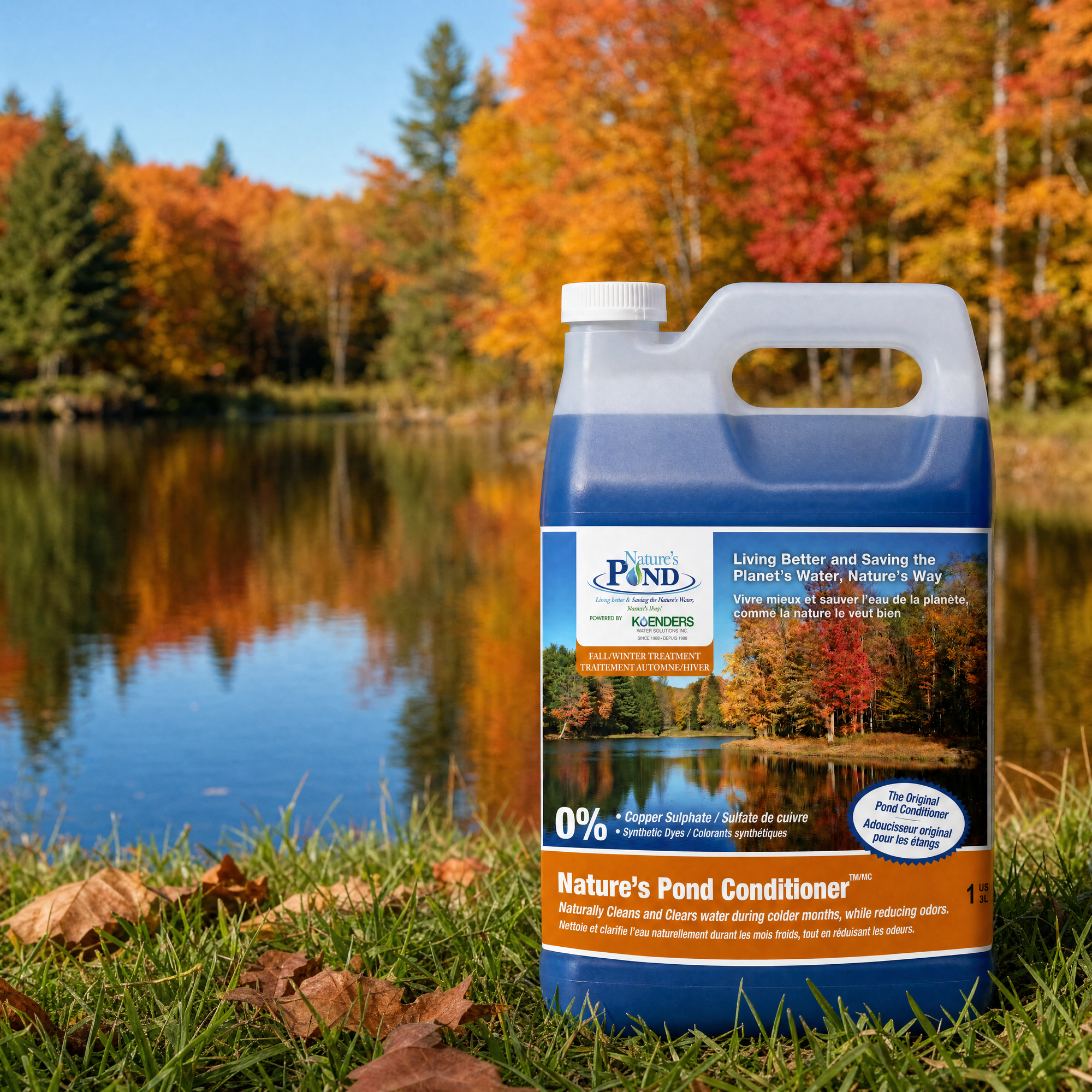
- Renew: add a beneficial-bacteria pond conditioner to seed the aerobic and anaerobic bacteria, enzymes, and plant extracts that break down organic waste. Nature's Pond Conditioner is an all-natural blend that converts organics to carbon dioxide and water, and it is safe for fish, pets, livestock, and wildlife when used as directed.
- Revive: run aeration to keep the water oxygenated and circulating, so those bacteria stay active and the bottom does not turn septic. Bottom-up diffused aeration outperforms surface aeration for mixing the whole water column.
- Remove: rake out the coarse debris, weeds, and sludge that biology cannot digest, and use dye to shade new submerged growth so it does not get a foothold.
In that system, dye plays a real but supporting role. It is the finishing touch that keeps light-hungry submerged weeds down while bacteria and oxygen do the actual cleanup. The bacteria need the oxygen from aeration to work quickly, which is why the pairing matters so much: without oxygen at the sediment, the beneficial bacteria that digest muck slow right down.
Off-grid ponds and dugouts with no power
The most common objection to aeration is power. Plenty of the ponds and dugouts that need it most sit far from any power line: back pastures, acreages, remote homesteads. This is where a lot of owners default to dye alone, simply because they assume aeration is not an option.
It is. Off-grid windmill aeration runs on wind alone, with no power line and no ongoing energy cost. A windmill drives an air compressor that pushes air down to diffusers on the pond bottom, oxygenating and circulating the water the same way an electric system does, just powered by the breeze. For sunny, low-wind sites, solar pond aeration uses panels and batteries to do the same job.
So the off-grid pond owner is not stuck choosing dye by default. You can aerate a remote dugout, add beneficial bacteria, and still finish with dye for the look and the extra shade. This matters especially for off-grid homesteaders and rural landowners whose water is doing double duty for livestock, wildlife, and recreation.
Lifetime cost: recurring dye vs durable aeration
It is tempting to reach for dye because the upfront number is small. A jug of dye costs a fraction of an aeration system, so on day one dye looks like the frugal choice. Over several seasons, the picture changes.
Dye is a recurring cost. It dilutes out with rain, inflow, and overflow, and it fades, so you reapply through the growing season, year after year. It never reduces the nutrient load, so the pond's underlying tendency to go green never improves. You are paying, on repeat, to mask the same problem.
Aeration is mostly upfront capital, and off-grid windmill units carry no energy bill at all. More importantly, aeration plus beneficial bacteria actually reduces the nutrient and muck load over time, so the pond gets easier to keep clear rather than harder. Compare that to the copper-sulphate cycle many owners fall into: copper kills algae that then sinks, rots, and refuels the next bloom, so you are locked into buying more every year. Aeration plus biology is the durable, lower-lifetime-cost path, and dye simply rides along on top as a cheap finishing touch.
Dye is a cost you pay again every season. Aeration is an investment that makes the pond easier to keep clear each year.
So do you need both?
For most ponds that go green or smell, yes, and in this order of priority: aeration and beneficial bacteria first, dye second. Aeration and biology fix the root cause. Dye is the affordable, good-looking supplement that shades new growth and gives the water a deeper, more natural tone.
If your pond is small, ornamental, and already balanced, you might get by with dye alone for the look. But if you are fighting recurring green water, muck, or odour, dye by itself will keep disappointing you, because it was never designed to solve those problems. Not sure what your pond actually needs? Our in-house pond experts will give you a free recommendation and estimate based on your surface acres, depth, and site.
How to measure your pond for either one
Whether you are dosing dye, sizing bacteria, or sizing aeration, it all starts with knowing your pond's volume. The number that matters is acre-feet.
- Measure surface area in acres: length times width in feet, divided by 43,560.
- Take several depth readings (near shore, mid-pond, and the deepest spot) and average them.
- Calculate acre-feet: surface acres times average depth in feet, divided by 4.
That acre-feet figure is what dye dosing, conditioner dosing, and aeration sizing are all based on, so it is worth getting right once. From there, dye follows its label rate and aeration is matched to your acreage, depth, and how exposed your site is. Rather than guess, send us those numbers and we will size the whole program for you at no cost through our pond experts.
Related
- Does pond dye actually work? Where dye helps and where it fails
- Pond aeration benefits, types and sizing How aeration works and how to size it
- Off-grid windmill aeration Wind-powered aeration, no power line needed
- Solar pond aeration Off-grid aeration for sunny sites
- The 3-step Pond Care Program Renew, Revive, Remove
- Talk to our pond experts Free sizing estimate and recommendation
FAQ