 Canada
 United States
Buying guide
How Long Does Pond Dye Take to Work and How Long Does It Last?
Pond dye disperses within hours and the colour usually holds for a few weeks. Water exchange is what really controls how fast it fades and when to reapply.
Last updated August 31, 2026
Pond dye usually disperses through the water within a few hours, faster with wind or aeration, and the visible colour typically lasts a few weeks per application. Longevity depends mostly on water exchange: heavy rain, a stream inflow, or an outflow dilute it out sooner. Reapply when the colour visibly fades, not on a fixed calendar.
You poured in your pond dye, watched the colour swirl out, and now you want to know two things: how long until it looks right, and how long before you have to do it again. The honest answer is that dye acts fast but fades on a schedule your pond sets, not one printed on a bottle. A closed pond holds colour for weeks. A pond with a stream running through it can look washed out in days.
Below is a straight, no-hype timeline: how quickly dye spreads, what actually makes it fade, how aeration changes the picture, and how to read your own water so you reapply at the right moment instead of guessing.
The short answer
Once it is in the water, liquid pond dye usually disperses within a few hours and the tint typically lasts a few weeks before it needs a top-up. The single biggest factor in how long it holds is water exchange. The more fresh water flows in and out of your pond, the faster the colour dilutes. A sealed, spring-fed or rain-only pond keeps colour far longer than a pond with a visible inflow or an overflow pipe.
Dye disperses in hours and lasts weeks, but water moving through your pond, not time on a calendar, is what decides when to reapply.
How fast does pond dye spread after you pour it in?
Concentrated liquid dye is heavier than water, so it sinks and streams out from where you pour it. On a breezy day, or with an aerator running, it mixes through the whole pond within a few hours and reaches an even colour. On a dead-still pond with no circulation, full, uniform colour can take most of a day as the dye slowly diffuses.
You can speed even coverage by pouring at several points around the shoreline rather than dumping it all in one spot, and by working on the upwind side so the breeze carries the tint across the surface. If your pond has an inlet, pour a little near it so incoming water helps distribute the colour. For a step-by-step on getting colour in early and evenly, see when to apply pond dye.
- Windy day or aerator running: a few hours to full, even colour.
- Still pond, no circulation: often most of a day for uniform colour.
- Poured at one spot: streaky at first, evens out as it diffuses.
- Poured at several points upwind: the fastest, most uniform result.
What makes pond dye fade faster
Dye does not chemically break down and vanish. It fades because it gets diluted and flushed out. Anything that swaps the water in your pond for new, un-dyed water shortens how long the colour holds. That is why two identical ponds treated on the same day can look completely different a month later.
| Factor | Effect on dye | What to do |
|---|---|---|
| Wind and aeration | Mix the dye faster and more evenly. Does not shorten how long colour lasts. | Let it work. You will see full colour sooner. |
| Heavy rain | Raises the level and can push dyed water out through an overflow, thinning the colour. | Check the tint after a big storm and top up if it has visibly lightened. |
| Stream or spring inflow | Constantly replaces dyed water with clear water, so colour fades quickly. | Expect shorter intervals. Smaller, more frequent doses hold better than one big dose. |
| Outflow or overflow pipe | Carries dyed water out every time the level rises, the biggest drain on longevity. | Reapply more often, or dose lightly and top up as needed. |
| Closed pond (no in or out) | Holds colour the longest because water is not being exchanged. | Reapply only when the colour genuinely fades, often several weeks apart. |
As a rough rule, ponds that turn over a large share of their water each month lose colour noticeably faster than closed ponds. Rather than chasing an exact percentage, watch your own overflow: if water is regularly leaving the pond, plan on reapplying sooner.
How aeration affects dye
People often assume that running an aerator will "blow out" their dye faster. It does not. Aeration circulates water within the pond, it does not add or remove water, so it mixes the colour more evenly and helps you see full colour sooner without meaningfully shortening how long the tint lasts.
Aeration matters far more for pond health than for dye longevity. Bottom-up diffused aeration raises dissolved oxygen and keeps beneficial bacteria working on the nutrients and muck that feed algae, which is the real root-cause work dye cannot do. If you want the fuller picture of how the two tools divide the labour, read pond dye vs aeration and our overview of how pond aeration works. For rural ponds with no power line, off-grid windmill aeration does the same circulating work on wind alone.
How often should you reapply pond dye?
Reapply when the colour visibly fades, not on a fixed calendar. In the growing season that often works out to every few weeks, but it swings widely with your pond's water exchange. A closed acreage pond might go a month or more between top-ups, while a pond with an active outflow may need attention every couple of weeks.
The most reliable gauge is your own eye. Pick a reference: the point where you can just start to see the bottom shelf, or a fixed marker like a dock post. When the tint has clearly lightened past that point, it is time to top up. Because dye is cumulative, you can always add more to deepen a fading colour. It is much harder to undo an overdose, so when in doubt, add a little and check the next day. For the volume side of the math, see how much pond dye you need.
Watch the colour, not the calendar. When the tint has clearly lightened, top up. You can always add more; you cannot take dye back out.
A simple season schedule
Pond dye is a preventive shade tool, so the goal is to keep colour in the water through the months when submerged algae and weeds want to grow. Here is a practical rhythm most pond owners can follow, adjusted for how much water moves through their pond.
- Early spring: Apply your first dose as the water warms and before submerged growth takes off, so the shade is in place ahead of the season's flush.
- Late spring to summer: Check the colour every couple of weeks and top up when it fades. Ponds with inflow or an outflow will need it sooner.
- After heavy rain or a big storm: Look at the tint. If the level rose and pushed water out, expect the colour to be lighter and reapply if needed.
- Fall: As growth slows, you can let the colour ease off. There is little benefit to dyeing under ice, when light and growth are already low.
Timing the first application well matters more than any single reapply date, so it is worth reading up on when to apply pond dye before the season starts.
Dye is one tool, not the whole plan
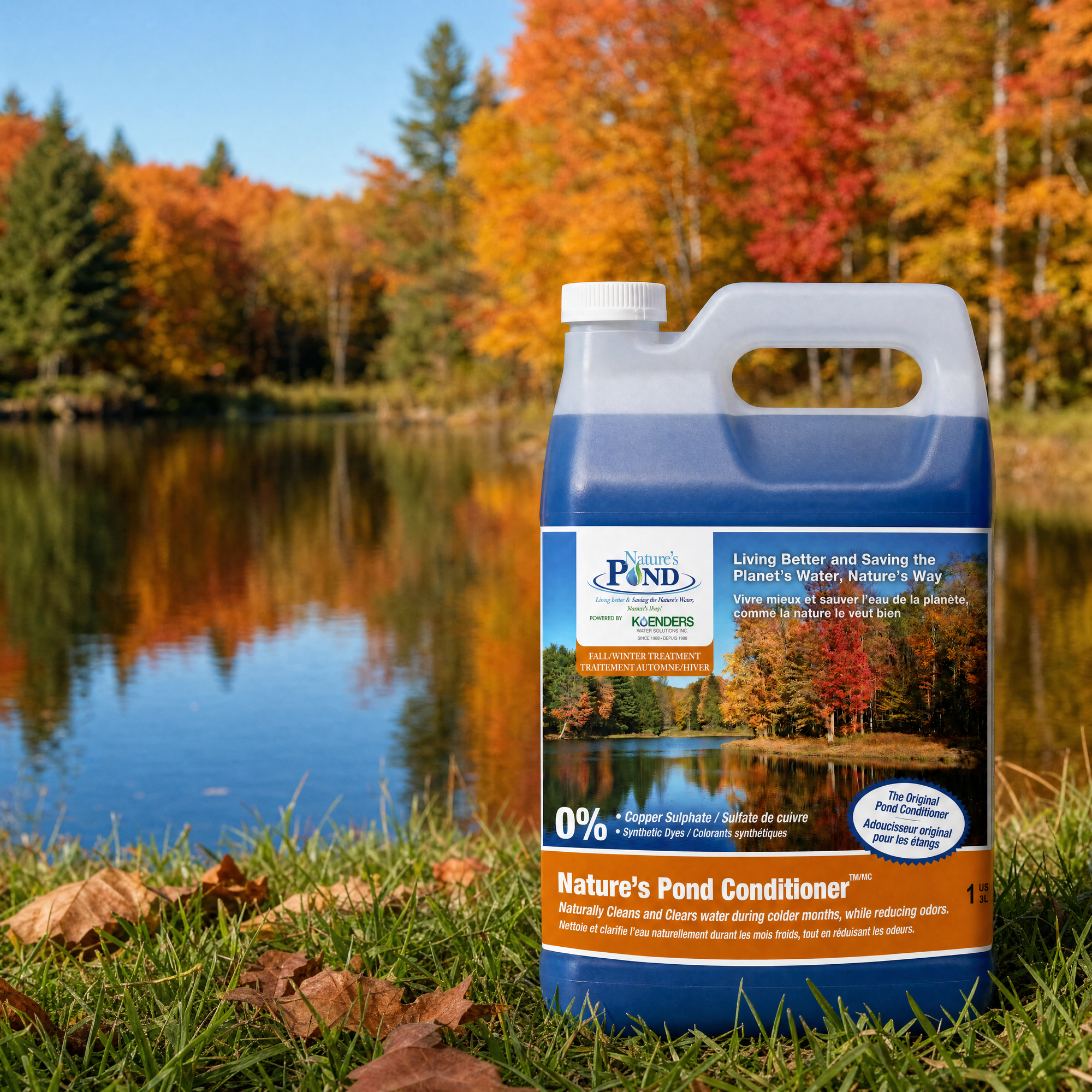
Reapplying dye keeps your pond looking good, but colour on its own does not fix why a pond turns green. That is the job of the 3-step Pond Care Program: condition the water with beneficial bacteria, aerate to add oxygen and circulation, and remove muck mechanically. Nature's Pond Conditioner is an all-natural blend of aerobic and anaerobic beneficial bacteria, enzymes, and plant extracts that digests excess organics into carbon dioxide and water, and it is safe for fish, pets, livestock, and wildlife when used as directed.
Used inside that program, dye becomes the finishing touch that shades new growth while the bacteria and aeration handle the root cause. When you are ready to restock, browse the natural pond dyes collection, and if you want a second opinion on dosing or a full plan for your water, our in-house pond experts will give you a free recommendation. For the complete rundown on colours, dosing, and safety, see the full pond dye guide.
Frequently asked questions
Related
- When to apply pond dye Spring timing and how to apply from shore
- Pond dye vs aeration Which one your pond actually needs
- How pond aeration works Benefits, types, and sizing
- Shop natural pond dyes Restock blue and black pond dye
- The 3-step Pond Care Program Renew, Revive, Remove
- Talk to a pond expert Free dosing and plan recommendation
FAQ