 Canada
 United States
Comparison
Copper Sulfate vs Peroxide Algaecide: Which Is Actually Safe for Koi?
Copper sulfate is toxic to koi at low levels and builds up in sediment. Peroxide is gentler but still a chemical. Here is the honest comparison and the durable koi-safe path.
Last updated August 31, 2026
Copper sulfate is not safe for koi. Copper is toxic to koi at about 0.15 ppm and accumulates in pond sediment where it stays reactive. Peroxide-based algaecide breaks down into water and oxygen and leaves no lasting residue, so it is gentler, but it is still a chemical fix. The durable koi-safe path is aeration plus beneficial bacteria.
The short answer for koi keepers
If you keep koi, copper sulfate is the wrong tool. Copper is toxic to koi at concentrations as low as about 0.15 ppm (0.15 mg/L), which is dangerously close to the amount you would apply to knock back algae, and koi are noted as a particularly sensitive species. Worse, copper does not simply do its job and disappear. It settles into the bottom sediment and stays reactive, so every dose stacks on the last.
Peroxide-based algaecide is genuinely gentler because it breaks down into water and oxygen and leaves no lasting residue in the pond. But gentler is not the same as a fix. It still treats the symptom, the visible algae, without touching the surplus nutrients feeding the bloom, so the algae comes back and you dose again. For a stocked koi pond, the approach that actually holds is not an algaecide at all: it is aeration paired with beneficial bacteria that consume the nutrients algae feed on.
Copper does not leave. It sinks into the sediment and stays reactive, so every treatment stacks on the last one.
Copper sulfate: why 0.15 ppm matters
The reason copper is so risky in a koi pond is the razor-thin margin between the dose that stresses algae and the dose that harms fish. According to the NPIC copper sulfate fact sheet from Oregon State University, fish vary widely in copper sensitivity, and trout and koi sit at the sensitive end. When the effective algae dose and the harmful fish dose nearly overlap, there is very little room for a measuring error, an uneven mix, or a warm day that shifts the water chemistry.
How copper damages gills
Copper is a gill toxicant. In the concentrations used for algae control it interferes with the delicate gill tissue koi use to pull oxygen from the water and regulate salts. Fish that survive an exposure can carry lasting gill damage, which quietly lowers their tolerance for the next stressful event: a hot afternoon, a heavy feeding, or the oxygen dip that follows a dying algae bloom.
Why soft, low-alkalinity water makes copper far more toxic
The same copper dose is not equally dangerous in every pond. In soft water with low alkalinity there is less dissolved mineral content to bind and buffer the copper, so more of it stays in the free, bioavailable form that reaches fish gills. A dose that koi tolerate in hard, well-buffered water can be lethal in soft water. Because most owners do not test alkalinity before dosing, this is one of the most common ways a copper treatment goes from routine to fatal.
Copper accumulates in sediment (the long-term problem)
Even if a single dose goes perfectly, copper does not clear out of the pond. It binds to organic matter and settles into the bottom muck, where it accumulates dose after dose and can stay reactive for years. Over time this stresses the beneficial organisms living in the sediment, the same organisms that break down muck and keep the water balanced, and it leaves a growing reservoir of copper the next disturbance can stir back up. This is why copper accumulates in pond sediment is a genuine long-term reason to avoid chronic copper use, separate from the acute fish risk.
Peroxide algaecide: what breaks down and what does not
Hydrogen peroxide and the sodium percarbonate products built around it work by oxidising algae cells directly, then breaking down into water and oxygen. That decomposition is real chemistry and it is the honest advantage of peroxide: there is no copper left to build up in the sediment, and no heavy-metal reservoir accumulating on the pond bottom.
What does not change is the underlying problem. Peroxide still kills the visible bloom without removing the phosphorus and nitrogen that caused it, so the bloom returns and you treat again. And like any algaecide, a heavy peroxide treatment can trigger an oxygen crash: the algae it kills then decays, and decomposition pulls dissolved oxygen out of the water. That is exactly why treating algae in a koi pond, with any product, means running aeration continuously and never treating the whole pond at once. We cover that safety protocol in why algaecide kills koi.
Copper vs peroxide vs biology: a side-by-side
| Method | Active principle | Koi risk | Residue / sediment | Durability |
|---|---|---|---|---|
| Copper sulfate | Copper ion toxic to algae (and fish) | High. Toxic to koi around 0.15 ppm; gill damage; worse in soft water | Accumulates in sediment and stays reactive | Low. Kills the bloom, does not remove nutrients, so it returns |
| Peroxide algaecide | Oxidises algae, breaks down to water and oxygen | Lower than copper, but oxygen crash risk from decaying algae | No lasting residue; nothing accumulates | Low. Still a symptom treatment; the bloom comes back |
| Beneficial bacteria + aeration | Bacteria consume the nutrients algae feed on; oxygen keeps water aerobic | Fish-safe when used as directed; supports the biofilter | None. It removes organic load rather than adding a chemical | High. Treats the cause, so blooms shrink season over season |
"Koi-safe" label claims vs the evidence
Plenty of algaecides carry reassuring words like pond-safe or fish-friendly on the front of the bottle. Read the fine print and you often find dosing warnings, a caution to treat only part of the pond at a time, and instructions to keep water moving during treatment. Those warnings exist because the oxygen-crash and gill-damage risks are real, even for products marketed to hobbyists.
A label claim is also not the same as testing in koi specifically. Species differ enormously in sensitivity, and a product that is genuinely low-risk for a farm pond stocked with hardy fish can still stress prized koi. When your fish are the whole point of the pond, the safest posture is to treat the cause and reserve any chemical for a genuine emergency, treated cautiously with full aeration.
The copper-free, chemical-free alternative
There is a reason we keep steering back to the same answer: the durable koi-safe path does not rely on killing algae at all. It removes what algae need to grow. Excess nutrients, chiefly phosphorus and nitrogen, feed the bloom; low oxygen and a septic, anaerobic bottom make it worse. Fix those and the algae has nothing to live on.
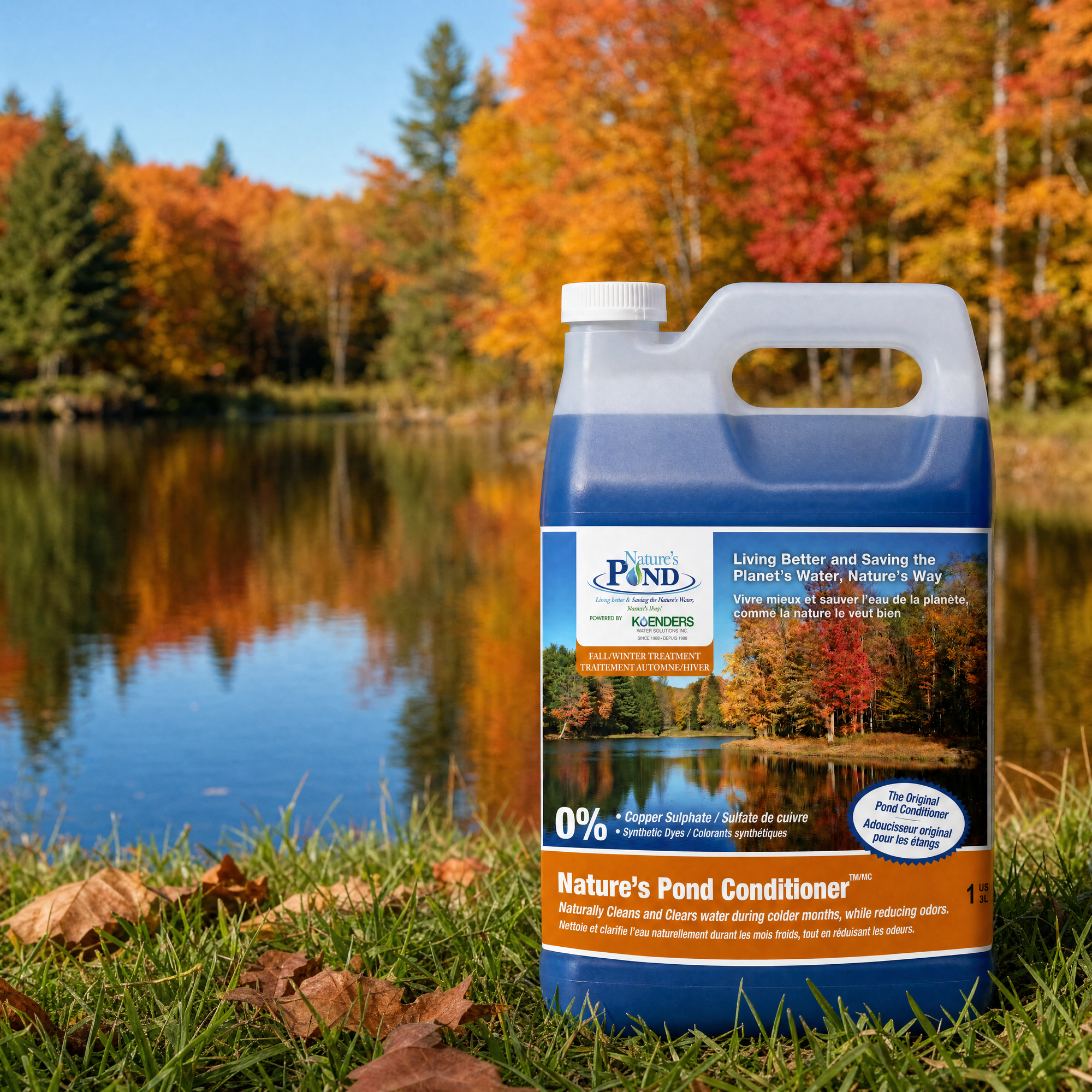
That is the whole idea behind the 3-step Nature's Pond Care Program. Renew conditions the water with beneficial bacteria and enzymes. Revive adds oxygen from the bottom up so the pond stays aerobic and the bacteria can actually work. Remove clears the organic muck those nutrients came from. Nature's Pond Conditioner is an all-natural blend of aerobic and anaerobic beneficial bacteria, enzymes, and plant extracts with a food-grade dye. It converts organic waste to carbon dioxide and water, is non-pathogenic, and is safe for fish, pets, livestock, and wildlife when used as directed.
- No heavy metals in the sediment. Beneficial bacteria digest organic load instead of leaving a copper reservoir on the pond bottom.
- It protects your biofilter rather than harming the nitrifying bacteria a koi pond depends on to control ammonia and nitrite.
- It gets stronger over time. Because it removes nutrients rather than killing the bloom, each season starts with less to feed the algae.
- It pairs with the safety layer you already need. Aeration keeps dissolved oxygen in the healthy 6-9 mg/L range koi thrive in, and gives the bacteria the oxygen they need to be effective.
The one honest caveat: biology is not instant. Beneficial bacteria works gradually and only with enough oxygen and warm-enough water, so pair it with continuous off-grid or solar aeration rather than expecting a same-day clear. For prized fish that is a fair trade, and it is the approach we recommend across all our koi and ornamental pond care. If you want a plan matched to your pond, our in-house pond experts will build one with you at no cost: reach out for a free recommendation.
The bottom line
Copper sulfate is not safe for koi. It is toxic at low concentrations, more dangerous in soft water, and it accumulates in the sediment where it keeps causing problems. Peroxide algaecide is the gentler chemical because it breaks down cleanly and leaves no residue, but it is still a symptom treatment that lets the bloom return. If you keep koi, skip the algaecide arms race: aerate the pond, add beneficial bacteria, and treat the cause so clear water and living fish are not competing goals.
Related
- Fish-safe pond and koi care The safety-first hub for clear water without fish loss
- Why algaecide kills koi The oxygen crash and how to treat algae safely
- Copper sulfate alternatives The hidden costs of copper and better natural fixes
- Copper-free pond conditioners Beneficial bacteria that treat the cause of algae
- The 3-step Pond Care Program Renew, Revive, Remove for a balanced pond
- Talk to our pond experts Free recommendation matched to your koi pond
FAQ