 Canada
 United States
Natural care
Fish-Safe Pond and Koi Care: How to Get Clear Water Without Hurting Your Fish
The safety-first way to clear a koi pond: aerate first, treat the cause not the symptom, and choose beneficial bacteria over copper algaecide.
Last updated August 31, 2026
To clear a koi pond without hurting your fish, aerate first, then treat the cause, not the symptom. Keep dissolved oxygen at 6-9 mg/L, treat no more than one third of the pond at a time, and choose beneficial bacteria over copper algaecide, which can crash oxygen as dead algae decays.
If your pond has turned green, smells off, or your fish are acting strangely, the instinct is to reach for the strongest algae killer on the shelf and fix it today. That instinct is exactly what causes most avoidable koi deaths. The fastest chemical fix is often the one that suffocates the fish you were trying to protect.
This is the safety-first guide to clearing a pond without harming the life in it. The order matters more than the product: aerate first, then treat the cause, not the symptom. Everything below builds on that single rule, from the panic-treatment mistake to the honest comparison of chemical versus biological control, to the emergency steps if your fish are gasping right now.
Clear water and healthy water are not the same thing. Chasing clarity with a chemical can cost you the fish.
The one rule that keeps koi alive: aerate first, treat second
Almost every fish-safe decision in a pond comes back to one number: dissolved oxygen. Koi need it constantly, and the moment it drops too low they suffocate, no matter how clear the water looks. Most pond treatments, and most pond problems, work by pushing oxygen down. So before you change anything else, you keep oxygen up.
Aeration is the layer that makes every other step safe. Running continuous bottom-up aeration holds dissolved oxygen in the healthy range so that when algae dies (whether on its own or because you treated it) the decay does not pull the water down into a fish kill. If you take one thing from this guide: never treat a pond you are not also aerating.
- Aerate 24/7 before, during, and after any treatment, not just when there is a problem.
- Target dissolved oxygen of 6-9 mg/L, with roughly 5 mg/L the minimum koi tolerate well.
- Treat the cause (excess nutrients and low oxygen), not the visible symptom (green colour).
- Go slow. Never treat more than about one third of the pond at a time.
Why clear water and healthy water are not the same thing
Water clarity is what you see. Water health is what your fish live in. They often move in opposite directions when you start dosing chemicals. A pond can go crystal clear the day after an algaecide and still lose its fish that week, because the thing that cleared the water is the same thing that pulled the oxygen out of it.
Green water rarely kills koi. Panic over-treatment does.
Green water is suspended single-celled algae. It is usually a cosmetic problem, and koi commonly live in it comfortably. The real danger is the reaction to it. When someone kills a heavy bloom overnight, the entire mass of algae dies and begins to rot at once, and the decomposition consumes the oxygen the fish depend on. The bloom did not kill the fish. The rescue did.
So the first move with green water is not a product. It is to stay calm, confirm the fish are otherwise fine, and fix the underlying nutrient load gradually. If you want the ranked, step-by-step version, see how to clear green koi pond water without killing your fish.
The real killers: low dissolved oxygen and copper gill damage
Two mechanisms account for the great majority of treatment-related koi deaths. The first is the oxygen crash from decaying organic matter, which can strike days after a treatment, not during it. The second is copper toxicity, which damages fish gills directly. Copper is toxic to koi at roughly 0.15 ppm, a threshold cited by extension and pesticide-information sources such as the NPIC Copper Sulfate fact sheet, and the effective algae dose sits uncomfortably close to the harmful one.
Neither killer announces itself in the water's colour. That is the trap. The pond can look better than it has all summer while oxygen is quietly falling overnight and copper is stressing gills. This is why experienced keepers watch fish behaviour, not water clarity, as their real early-warning system.
What actually makes a pond go green and mucky
You cannot pick the right fix until you know what you are fixing. Nearly every algae, muck, odour, and fish-kill problem traces back to the same root cause: excess nutrients plus low dissolved oxygen plus anaerobic bottom sediment. Phosphorus and nitrogen from fish waste, uneaten food, leaves, grass clippings, and runoff pile up faster than the pond can process them, and algae is simply the organism best positioned to eat that surplus.
When the bottom runs short of oxygen, the sediment turns anaerobic and septic. That is where the rotten-egg smell comes from, and it is also where nutrients get released back into the water instead of being locked away. A chemical that kills the visible algae does nothing about any of this. It leaves the fuel in place and often adds to it, because the dead algae becomes more organic sediment. The durable fixes all work by lowering nutrients and raising oxygen, which is exactly what a biological program plus aeration is built to do.
- Excess nutrients (phosphorus and nitrogen) are the fuel. Reduce them and blooms starve.
- Low dissolved oxygen lets the bottom go septic and recycles nutrients back into the water.
- Anaerobic sediment is the reservoir. Aeration and beneficial bacteria digest the organic part of it.
The fish-safety chain, start to finish
Understanding the chain of events is what lets you break it. Here is exactly how a routine algae treatment turns into a fish kill, step by step, and where you intervene.
Step 1: dead algae decays and consumes oxygen
Living algae actually produces oxygen during the day. When you kill a large bloom, that oxygen production stops and decomposition takes over. Bacteria breaking down the dead algae draw dissolved oxygen out of the water, and in a warm, heavily stocked pond that demand can outpace whatever the surface can replace. Oxygen falls, usually lowest just before dawn, and the fish are the first to feel it.
Step 2: copper damages gills, worse in soft, low-alkalinity water
Copper-based algaecides add a second, independent risk. Copper injures gill tissue, and its toxicity rises sharply in soft, low-alkalinity water where less of the copper is buffered into a harmless form. The same dose a hard-water pond shrugs off can be lethal in soft water. If you are weighing chemistries, we break the trade-offs down in copper sulfate vs peroxide algaecide for koi.
Step 3: the mandatory-aeration protocol (treat one third, aerate 24/7)
If you must treat at all, this protocol is what keeps the chain from completing. Aeration replaces the oxygen decay removes, and treating in sections keeps the amount of dying algae small enough that the oxygen demand never overwhelms the fish.
- Run aeration at full output for at least 24 hours before you treat anything.
- Treat no more than one third of the pond surface at a time.
- Wait several days, watching the fish, before treating the next section.
- Keep aeration running continuously through the entire process and after.
- Never use a pool or farm-pond algaecide in a stocked koi pond.
Chemical vs biological: the honest comparison
The core question every koi keeper eventually asks is whether to kill algae with a chemical or manage it with biology. The honest answer is that they solve different problems on different timelines, and only one of them addresses the reason the algae is there at all.
What copper algaecide actually does over time
Copper sulfate works, and it works fast, which is why it is popular. But look at the full cycle: it kills the algae, the dead algae sinks, it rots on the bottom, and that decay releases the nutrients back into the water, which feeds the next bloom. Meanwhile copper binds to sediment and accumulates with every application, staying reactive where fish and beneficial organisms live. You end up dosing more often to hit the same result. This is the pattern we cover in depth in copper sulfate alternatives for pond algae.
How beneficial bacteria and aeration break the cycle
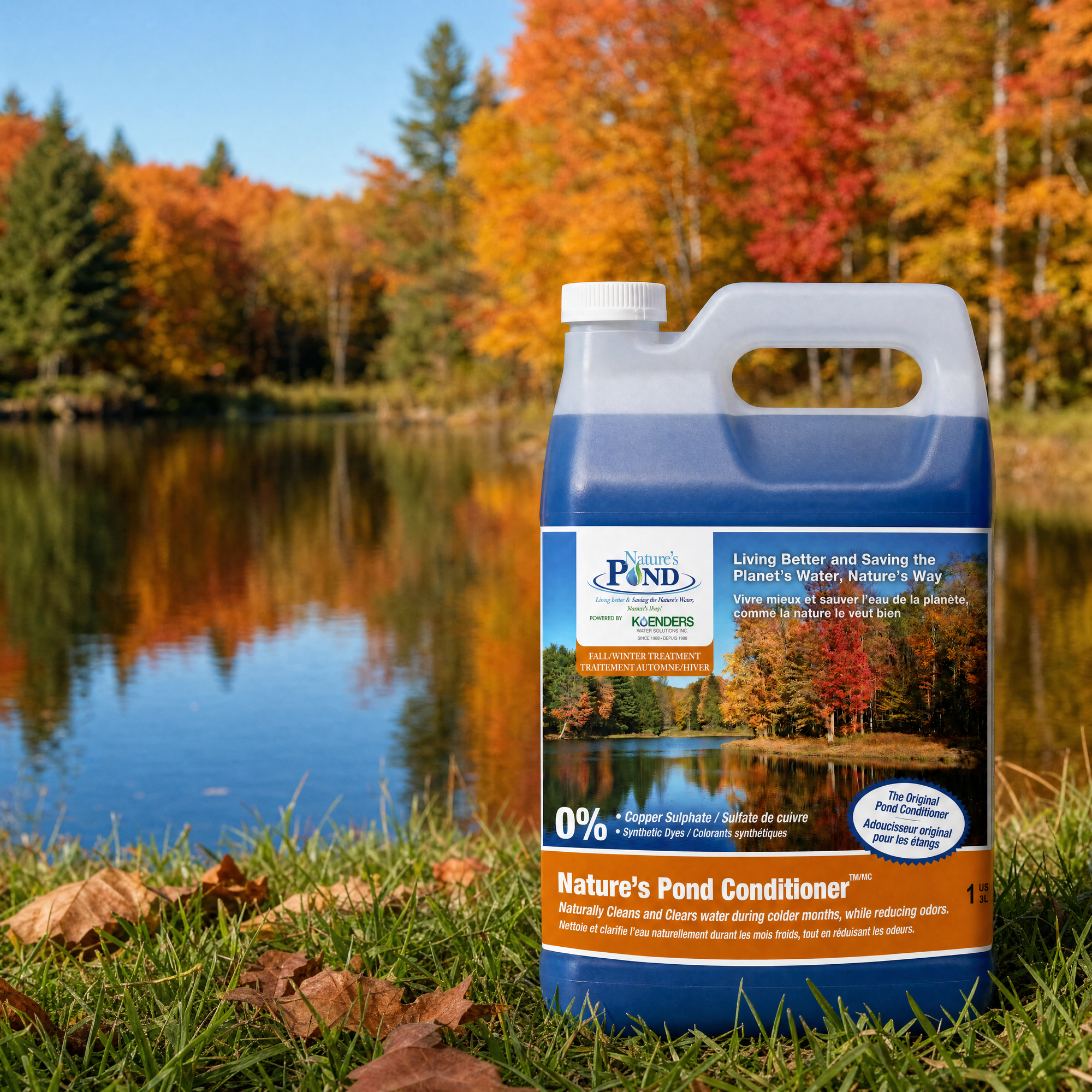
The biological approach attacks the fuel instead of the flame. Nature's Pond Conditioner is an all-natural blend of aerobic and anaerobic beneficial bacteria, enzymes, and plant extracts with a food-grade dye. The bacteria consume the excess phosphorus and nitrogen that algae feed on, converting that organic load to carbon dioxide and water. It is non-pathogenic and safe for fish, pets, livestock, and wildlife when used as directed. Starve the nutrients and the blooms have nothing to grow on.
The catch, and we say it plainly where competitors bury it: beneficial bacteria works best in oxygen-rich water. That is why it is always paired with aeration rather than sold as a standalone miracle. The two together are the durable fix.
There is one more honest caveat. Biology is not instant. A chemical clears water in a day; a biological program shifts the pond over weeks as the bacteria establish and the nutrient load comes down. What you trade for that patience is a pond that gets easier every season instead of one you have to rescue again next summer. For most koi keepers, the peace of mind of never fearing a treatment-day fish kill is worth the slower start.
Lifetime cost: chronic dosing vs one aeration plus bacteria program
Chemical control is a recurring cost with no end. Every season you buy more, dose more, and often more frequently as sediment builds. A biological program is mostly an upfront investment in aeration plus a maintenance dose of bacteria, and because it removes the nutrient load instead of recycling it, the problem gets easier over time rather than harder.
| Approach | What it does | Fish-safety risk | Lifetime cost | Best use |
|---|---|---|---|---|
| Copper sulfate algaecide | Kills algae fast; it sinks, rots, and refuels the next bloom | High: gill damage near ~0.15 ppm, plus oxygen crash from decay | Recurring, tends to rise as sediment builds | Rarely, and never in a stocked koi pond without aeration |
| Peroxide algaecide | Oxidizes algae; breaks down to water and oxygen, no lasting residue | Lower than copper, but still a chemical shock and oxygen demand | Recurring | Spot treatment only, with aeration running |
| Beneficial bacteria + aeration | Consumes the nutrients feeding algae; keeps water oxygenated | Low: fish-safe as directed, no oxygen crash | Mostly upfront, eases over time | Ongoing prevention and durable control |
The 3-step fish-safe program (Renew, Revive, Remove)
Everything above comes together in the 3-step Nature's Pond Care Program: Renew, Revive, Remove. It is the same aerate-first, biology-second order, packaged as a season-long routine rather than a one-time rescue.
Renew: condition with beneficial bacteria and enzymes
Renew means seeding the pond with beneficial bacteria and enzymes so the biological engine that digests organic waste is actually present and active. In a new or long-neglected pond this starts with a fuller dose to establish the population, then steps down to maintenance through the warm season.
Revive: oxygenate from the bottom up
Revive is aeration, and it matters that it comes from the bottom. Bottom-up diffused aeration outperforms surface aeration for destratification: it lifts low-oxygen bottom water, circulates the whole column, and delivers oxygen right at the sediment where the muck and the anaerobic zone live. For remote or unpowered ponds, off-grid aeration systems run without a power line at all.
Remove: mechanical and biological nutrient removal
Remove is about physically taking nutrients out: skimming debris, raking out heavy weed and muck, and letting the bacteria digest the organic layer that remains. Every leaf and every dead strand of algae you pull is fuel that never gets a chance to feed the next bloom.
When you have an emergency right now
If your koi are hanging at the surface, gulping air, or piling near a waterfall or inflow, treat it as a low-oxygen emergency and act before you diagnose. The early morning is the most dangerous window, because overnight respiration has drawn oxygen to its lowest point.
- Turn all aeration to maximum immediately; add a spare pump, fountain, or even a garden hose spraying the surface if you have nothing else.
- Stop all feeding and stop any treatment in progress.
- Do a partial water change with dechlorinated water to dilute the load and add oxygen.
- Do not net or move fish unless they are in immediate danger, since handling adds stress.
- If fish keep dying, call a specialist. Our in-house pond experts are reachable through contact us.
Choose your path
Wherever you are in the process, there is a next step below. Every one of these keeps the fish-safe order intact.
- New to natural care? Start with the 3-step Pond Care Program.
- Green water panic? Read how to clear green koi pond water.
- About to reach for a chemical? Read why algaecide kills koi first.
- Comparing biology to chemicals? See beneficial bacteria vs algaecide.
- Want the deeper water-quality basics? See our koi pond water quality and filtration guide.
- Shopping for a durable fix? Browse beneficial bacteria pond conditioners.
Not sure what your specific pond needs, or how much? Skip the guesswork and get a free recommendation from our pond experts. Tell us your surface size, average depth, and fish load, and we will help you size aeration and dosing so you treat safely the first time.
Frequently asked questions
Related
- The 3-step Pond Care Program Renew, Revive, Remove for clear, living water
- Fish-safe care for koi and ornamental ponds Solutions built for koi keepers
- Beneficial bacteria pond conditioners The copper-free, fish-safe alternative
- Off-grid aeration systems Oxygenate remote ponds with no power line
- Why algaecide kills koi The oxygen crash, explained
- Koi pond water quality and filtration guide The water-quality fundamentals
FAQ