 Canada
 United States
Diagnostic guide
Why Algaecide Kills Koi (And How to Treat Algae Without an Oxygen Crash)
Algaecide can kill koi two ways: copper gill damage and an oxygen crash as dead algae decays. Here is the mechanism and the fish-safe protocol.
Last updated August 31, 2026
Algaecide kills koi two ways. Copper is toxic to koi at about 0.15 ppm and damages their gills. Separately, when algaecide kills a bloom, the dead algae decays and consumes dissolved oxygen, which can crash oxygen and suffocate fish days later. To prevent this, aerate 24/7 and treat no more than one third of the pond at a time.
If you added an algaecide and then found fish gasping, floating, or dead a few days later, you are not imagining a connection. Algaecide is one of the most common causes of an avoidable koi loss, and the reason surprises most pond owners: the chemical often is not what kills the fish directly. What kills them is the aftermath.
This guide explains exactly why it happens, what the warning signs look like, and the safe protocol to follow if you feel you must treat. If your fish are in distress right now, jump straight to the emergency steps below, then come back for the why.
The short answer: two different killers
Algaecide can harm koi through two separate mechanisms, and they can stack on top of each other. The first is direct: copper-based algaecide is toxic to koi and injures their gills. The second is indirect and usually more deadly: when a heavy algae bloom dies all at once, the decaying algae consumes the dissolved oxygen your fish need to breathe.
That second mechanism is why fish so often die days after treatment rather than during it, and why the pond can look fine one evening and turn into a fish kill by the next morning. Understanding both is the key to never repeating it.
The algaecide rarely suffocates your koi. The dead algae it leaves behind does.
Killer 1: the oxygen crash from decaying algae
A green or matted pond can hold an enormous amount of living algae. While that algae is alive it actually produces oxygen during the day. Kill all of it at once and you flip the pond from an oxygen producer to an oxygen consumer overnight. Bacteria move in to break down the dead algae, and that decomposition pulls dissolved oxygen out of the water fast.
Koi need dissolved oxygen of at least 5 mg/L to stay healthy, with 6 to 9 mg/L considered ideal. When a mass of algae decays, oxygen can fall well below the safe range, especially in the pre-dawn hours when there is no sunlight driving any remaining plant life. Fish crowd the surface, gulp at the air, and can suffocate even though the algaecide itself stayed within its label limits.
Why fish often die days after treatment, not during
Decay is not instant. It can take a few days for the killed algae to fully break down and for the oxygen demand to peak. That lag is exactly why so many owners do not connect the dots: the treatment went in on the weekend, the water looked clearer, and the fish were fine, then Wednesday morning brought a die-off. The oxygen crash is a delayed reaction, and it is at its worst in warm water, which both holds less oxygen and speeds up decomposition.
Killer 2: copper gill damage
The second mechanism is the chemistry itself. Copper sulphate and other copper-based algaecides are directly toxic to koi. Public health and pesticide references note that koi and trout are particularly sensitive species, with copper toxicity to koi setting in around 0.15 ppm (0.15 mg/L). Copper injures the delicate gill tissue fish use to extract oxygen, which is a cruel combination when the water is already losing oxygen to decay.
The trouble is the narrow margin for error. In a stocked koi pond the dose that clears algae can sit uncomfortably close to the dose that harms fish, and copper does not simply disappear. It binds to bottom sediment and accumulates with repeated dosing, where it can stay reactive. That long-term buildup is one more reason copper is a poor fit for a pond you actually care about. We compare the chemistries in detail in copper sulphate vs peroxide algaecide for koi.
Why soft, low-alkalinity water makes copper more dangerous
Water chemistry changes how toxic copper is. In soft, low-alkalinity water there is less buffering, so more of the copper stays in the bioavailable form that harms fish. The exact same dose that a pond tolerates in hard water can be lethal in soft water. If you do not know your alkalinity, you are dosing blind, which is one more argument for not reaching for copper at all.
| Mechanism | How fast | Warning sign | How to prevent |
|---|---|---|---|
| Oxygen crash (algae decay) | Delayed, often 1-4 days later | Koi gasping at the surface, worst before dawn | Aerate 24/7; treat only 1/3 of the pond at a time |
| Copper gill damage | Hours to days | Rapid gilling, listless fish, clamped fins | Avoid copper; never use farm-pond or pool algaecide in a koi pond |
| Combined | Compounding | Sudden die-off after a warm, calm spell | Fix the cause biologically instead of dosing chemicals |
The safe protocol if you must treat
Sometimes you feel you have no choice but to knock back a bloom. If you are going to treat, these three rules are the difference between a nuisance and a fish kill. None of them are optional.
Aerate 24/7 before, during, and after
Aeration is the single most important safety layer, because it replaces the oxygen that decaying algae removes. Run it around the clock, and turn it up before you treat, not after you notice fish in distress. Bottom-up diffused aeration is best because it circulates the whole water column and keeps oxygen at the sediment where the decay is happening. If your pond has no power nearby, off-grid solar aeration can hold oxygen without a power line. For a full sizing walkthrough, see how much aeration a koi pond needs.
Treat only one third of the pond at a time
Never treat the whole pond in one pass. Treat no more than one third at a time and wait several days between sections so oxygen can recover. This limits how much algae dies and decays at once, so the oxygen demand never overwhelms your fish. It is a safeguard, not a guarantee, which is why it always runs alongside continuous aeration, never instead of it.
Never use pool or farm-pond algaecide in a koi pond
Products formulated for swimming pools or large farm ponds are not made for stocked ornamental water. Their copper concentrations and formulations can be far too aggressive for koi. If a label does not clearly speak to fish safety and koi, keep it away from your pond.
Emergency steps if your fish are gasping right now
If koi are hanging at the surface and gulping, treat it as an oxygen emergency and act in this order.
- Turn aeration to maximum. Every diffuser, pump, fountain, or waterfall you have goes on now. Surface agitation adds oxygen fast.
- Do a partial water change with dechlorinated water. Fresh, cooler, oxygenated water dilutes the oxygen demand and any chemical still in the pond.
- Stop all further dosing immediately. Do not add more algaecide to "finish the job." More dying algae means more oxygen loss.
- Move fish only if you can do it safely into aerated, temperature-matched water. A rushed transfer can stress them more than the pond.
- Call a pond specialist for a same-day recommendation before you make another change.
Once the crisis passes, the goal is to make sure it never happens again, and that means changing the approach rather than just the product.
The better long-term fix: aerate, then build biology
Algaecide treats the symptom. The green water and the mats are downstream of one root cause: excess nutrients, phosphorus and nitrogen, plus low oxygen and an anaerobic bottom. Kill the algae and leave those causes in place, and you get the same bloom again in a few weeks, often worse, because the last bloom rotted and refed the pond. That is the endless dosing treadmill.
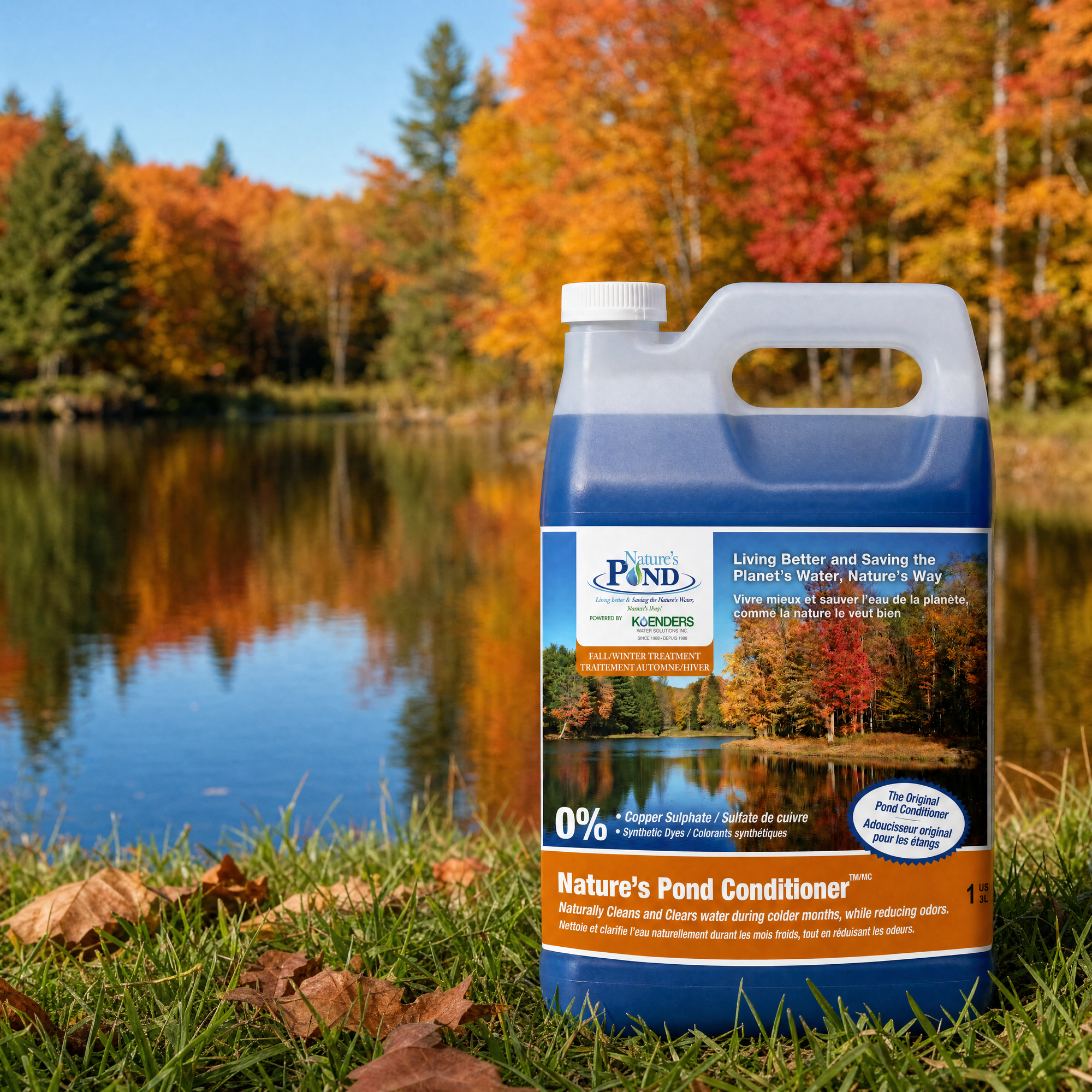
The durable path breaks the cycle. First aerate, so the pond holds oxygen and the bottom stays aerobic. Then build biology: beneficial bacteria pond conditioners consume the surplus nutrients that algae feed on, out-competing the bloom instead of poisoning it. Nature's Pond Conditioner is an all-natural blend of beneficial bacteria, enzymes, and plant extracts with a food-grade dye. It converts organics to carbon dioxide and water, is non-pathogenic, and is safe for fish, pets, livestock, and wildlife when used as directed.
This is the heart of the 3-step Nature's Pond Care Program: Renew with beneficial bacteria, Revive with aeration, and Remove the built-up muck mechanically and biologically. It is slower than a chemical hit, but it is fish-safe and it fixes the reason the pond went green in the first place. For the complete safety-first framework, start with our fish-safe pond and koi care guide.
If the bloom keeps returning and a rotten-egg smell has crept in, that low-oxygen bottom is speaking to you. See why a pond smells like rotten eggs and how to get rid of pond algae naturally. Not sure where your pond stands? Our in-house pond experts will give you a free recommendation at /contact.
Frequently asked questions
Related
- Fish-safe pond and koi care guide The safety-first hub for clearing water
- How much aeration a koi pond needs Dissolved oxygen targets and sizing
- Copper sulphate vs peroxide algaecide for koi The chemistry compared, honestly
- Off-grid solar aeration Hold oxygen without a power line
- Koi and ornamental pond care Care built around living fish
- The 3-step Pond Care Program Renew, Revive, Remove
FAQ