 Canada
 United States
Sizing guide
Pond Bacteria Dosing Guide: How Much Per Acre (Surface Acre vs Acre-Foot)
How much beneficial bacteria your pond needs, why depth matters, and how to dose by surface acre or acre-foot without guessing.
Last updated August 31, 2026
Dose pond bacteria by the label rate for your pond, measured either by surface acre or by acre-foot of volume. Surface acres times average depth gives acre-feet, so deeper ponds need more product than surface area alone suggests. Apply a fuller dose at startup, then maintenance doses through the warm season, and always follow the current product label.
How much pond bacteria do I need per acre?
The honest answer is that there is no single number that fits every pond, because a one-acre pond can hold anywhere from a shallow puddle to millions of litres depending on how deep it is. That is why the smart way to dose beneficial bacteria is to measure your pond two ways: by surface acre (the area of the water) and by acre-foot (the volume of the water). Once you know both, the current product label tells you the rate, and our in-house pond experts can confirm your dose for free so you are not guessing.
This guide walks through both measurements, the acre-feet formula, startup versus maintenance timing, and why a full dose matters. If you would rather skip the math, we do the sizing for you. For a broader look at quantities across bacteria, dye, and aeration together, see how much pond conditioner do I need.
Surface acre vs acre-foot: the two ways ponds are measured
Every dosing decision starts with one question: does the label dose by surface area or by water volume? The two are not interchangeable, and using the wrong one is the most common reason a pond is under-treated.
How to calculate surface acres
Surface acres describe the top area of your water, ignoring depth. For a roughly rectangular pond, multiply length in feet by width in feet, then divide by 43,560 (the number of square feet in one acre). A pond that is 200 feet by 218 feet is close to one surface acre. For irregular shapes, average your longest and shortest measurements, or measure from an aerial photo. Surface acres are what area-based products, such as some algae and surface treatments, dose against.
How to calculate acre-feet (surface acres x average depth)
An acre-foot is one surface acre of water one foot deep. To find your acre-feet, multiply your surface acres by your average depth in feet, not the deepest point. Average depth means walking or sounding several spots and taking the mean, because most ponds are far shallower around the edges than in the middle. A one-acre pond averaging six feet deep is six acre-feet of water, so it holds six times the volume of a one-acre pond averaging one foot deep. That is the whole reason depth changes your dose.
Two ponds can both be one acre on the surface and still need very different amounts of bacteria, because volume, not area, is what the microbes have to work through.
Reading the label: dose by surface area or by volume
Beneficial-bacteria conditioners are typically dosed by volume, because the bacteria have to digest the organic load throughout the water column and the muck on the bottom. That means acre-feet, not just surface acres, usually drives the amount. Always read your current label first: it will state whether the rate is per surface acre or per acre-foot, and it will give the startup and maintenance quantities. We deliberately do not publish a fixed litres-per-acre or pounds-per-acre figure here, because label rates change and the only correct number is the one printed on the jug you own. If you want that number translated into an exact dose for your pond, send us your dimensions and we will size it at no charge.
| Basis | What it measures | When the label uses it | How to calculate |
|---|---|---|---|
| Surface acre | The top area of the water | Area-based treatments (some surface products) | Length x width in feet ÷ 43,560 |
| Acre-foot | The volume of the water | Volume-based dosing (most bacteria conditioners) | Surface acres x average depth in feet |
| Sizing shortcut | A working volume estimate | Nature's Pond dye and treatment sizing | Surface acres x average depth ÷ 4 |
That last row is the Nature's Pond sizing shortcut: surface acres times average depth divided by four. It gives a working figure our team uses to size dye and treatment doses quickly, and it is a handy sanity check when you are estimating on your own.
How often to dose: startup vs maintenance
Bacteria dosing is not a one-and-done event. Think of it as establishing a population and then keeping it fed:
- Startup dose: a heavier application when the water first warms in spring, to build a strong bacterial population quickly.
- Maintenance doses: lighter, regular applications through the warm season to keep the population working as it consumes muck and nutrients.
- Tapering off: as water cools in autumn, warm-water bacteria slow down, so maintenance frequency drops. Cold-water-rated dosing takes over at the shoulders of the season.
We keep the exact interval to the label rather than inventing a day count, because startup and maintenance rates are set by your product and your pond's condition. What is universal: consistency beats intensity. A steady, full dose through the season outperforms one big pour in June and nothing after.
Liquid vs dry bacteria: does the form change the dose?
Both liquid and dry (granular) bacteria work. The difference is coverage, not effectiveness:
- Dry or granular sinks, which helps it reach and digest the muck layer on the bottom where the heaviest organic load sits.
- Liquid disperses through the water column and is quick to apply over a surface.
- Dose each by its own label rate. Do not convert one form to the other by weight or volume, because the concentrations differ. A pond with deep muck often benefits from a sinking form; a pond you are treating for water clarity may do fine with liquid.
Should you overdose or underdose?
Underdosing is the far more common mistake, and it is the most likely reason a treatment seems to "not work." A partial dose builds a partial population that gets overwhelmed by the pond's organic load. Apply the full labeled dose. At the same time, do not exceed the label: more bacteria is not proportionally better, it simply wastes product, and the real limiting factor is usually oxygen, not the amount of bacteria you added. If results are stalling despite a full dose, the fix is almost always aeration and temperature, which we cover next.
Temperature and oxygen: the two adjustments that change everything
Two conditions decide whether your dose actually performs, and neither is on the label as a quantity:
- Water temperature. Warm-water bacteria go dormant below roughly 50F, so dosing into cold water with the wrong formula wastes product. Match the formula to the season, and see adjusting the dose for water temperature for the spring and autumn timing.
- Dissolved oxygen. The bacteria that digest muck fastest are aerobic, meaning they need oxygen to work. In a low-oxygen pond, even a perfect dose stalls and the bottom turns septic. This is the single biggest lever on your results, and it is why we pair every dose with aeration. Read why oxygen changes your results before you decide your pond "needs more bacteria."
Getting the dose right is step one. Getting oxygen to the sediment where the muck sits is what makes that dose pay off. That pairing is the heart of the 3-step Pond Care Program: Renew by conditioning with the bacteria and enzyme blend, Revive by aerating, and Remove the remaining sludge mechanically and biologically.
Worked examples: how depth changes the amount
These examples show the principle, not a product quantity. Read your label for the actual rate, then apply it to the acre-feet you calculate.
- One-acre pond, six feet average depth: one surface acre but six acre-feet of volume. If your label doses by volume, you are treating six acre-feet, not one, so the amount is far larger than surface area alone would suggest.
- Quarter-acre pond, three feet average depth: 0.25 surface acres and about 0.75 acre-feet. A small, shallow pond needs a modest dose, but skipping the depth step still under-treats it.
- Two ponds, both one surface acre: one averages two feet deep (two acre-feet), the other averages eight feet deep (eight acre-feet). The deep pond needs roughly four times the volume-based dose. Same map view, very different jug.
If those numbers make your head spin, that is exactly what our team is for. Send your surface acres and average depth and we will calculate your dose for free, no calculator or spreadsheet required.
Which product to dose
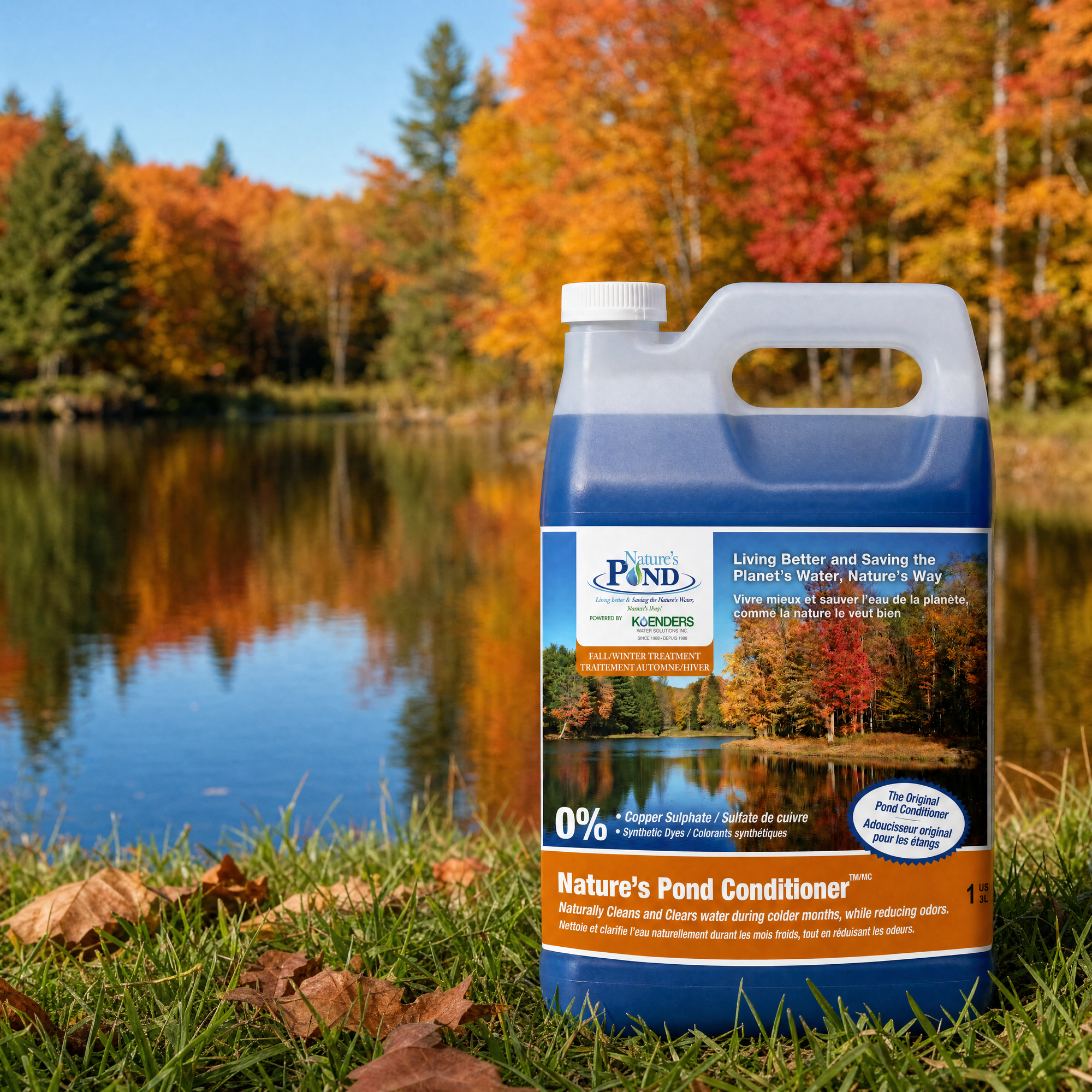
Nature's Pond Conditioner is an all-natural blend of beneficial bacteria, enzymes, and plant extracts with a food-grade dye. It converts organic waste to carbon dioxide and water, is non-pathogenic, and is safe for fish, pets, livestock, and wildlife when used as directed. That is the conditioner these dosing rates apply to. Browse the options in Nature's Pond Conditioner, then match your acre-feet to the label, or let us size it for you.
Measure the volume, apply the full label dose, keep the water warm and oxygenated, and repeat through the season. That is the whole formula.
Related
- Pond calculator Free: surface area, volume and acre-feet
- How much pond conditioner do I need Bacteria, dye and aeration sizing together
- Why beneficial bacteria needs oxygen The aeration pairing that decides results
- Cold-water vs warm-water pond bacteria Adjusting the dose for water temperature
- How beneficial bacteria and enzymes work The full mechanism-first guide
- Nature's Pond Conditioner The beneficial bacteria and enzyme blend
- Get a free dosing estimate Send your pond size, we size the dose
FAQ